Many managers of flat storage facilities try to solve problems with moisture and self-heating of grain in the simplest intuitive way: by installing more and more fans with ever greater power. In warehouse engineering practice, this is one of the most costly and least effective methods of stabilizing crops.
When the pile reaches a height of 3–4 meters, the grain at the bottom undergoes natural compaction under its own weight, creating a barrier with enormous hydraulic resistance.
Increasing the power of ventilation turbines then brings negligible effect with a drastic increase in electricity consumption. The solution to this problem is not forcing air under extreme pressure, but mechanical decompression of the bulk material, which is carried out by self-propelled grain stirrers from TechnoMaszBud.
1. The aerodynamic paradox of the pile: why do more powerful blowers fail?
Airflow through a grain layer is described by gas mechanics in porous media. The relationship between pressure drop and air filtration velocity in the bulk material is nonlinear. This means that to double the airflow through compacted raw material, the fan drive power must increase even several times over. As the aerodynamic resistance of the bulk material increases, fan efficiency drops sharply.
The phenomenon of preferential channels
Air forced in under high pressure always chooses the path of least resistance. In a compacted pile, so-called aerodynamic chimneys are formed – air streams blow through looser zones, while the most compacted, moist layers near the floor and in the core of the pile remain untouched.
The fan draws full rated power from the grid, cooling only selected parts of the material and leaving ignition hotspots untouched. This is like turning on air conditioning in a room and opening all the windows.
2. The mechanics of the vertical auger: eliminating resistance at the source
Instead of fighting aerodynamic resistance with powerful blowers, the grain stirrer removes the very cause of the problem.
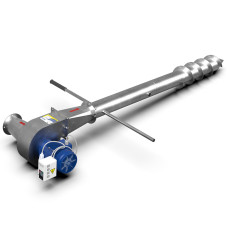
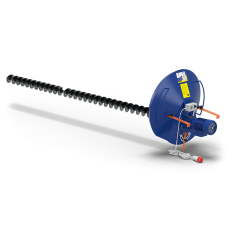
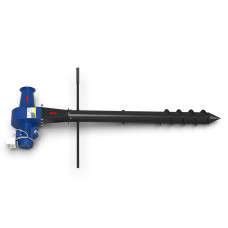
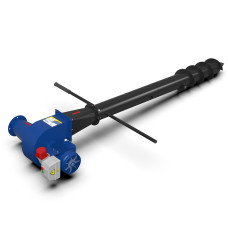
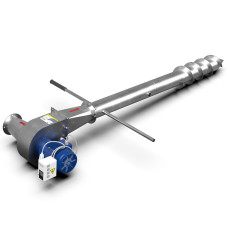
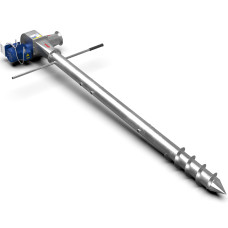
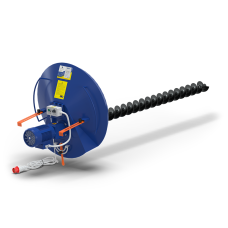
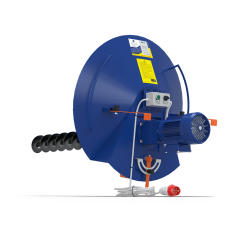
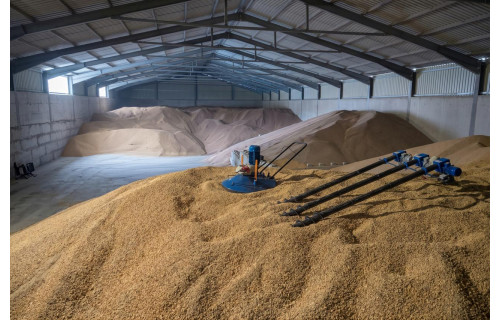
The grain stirrer is equipped with a vertical working auger that penetrates the entire depth of the pile down to the floor-adjacent layer. Then, during rotation, the auger of the grain ventilator:
- Lifts the lower layers of grain to the surface: Material with the highest moisture content and elevated temperature reaches the zone of free gas exchange with the surroundings.
- Breaks up compacted areas and lumps: It interrupts capillary bridges and loosens the geometric structure of the bulk material, sharply increasing its porosity.
- Opens the way for air: After a full working cycle of the stirrer, the aerodynamic resistance of the pile drops by several dozen percent.
Thanks to this, a standard, energy-saving grain aerator or an underfloor duct system of moderate power can evenly force air through the entire mass of stored material without the need to operate under overload.
3. Energy balance: a 3 kW grain stirrer versus high-power turbines
A comparison of operating costs clearly indicates the advantage of mechanical grain agitation over intensive pressure blowing:
- Traditional pressure ventilation of a compacted pile: It requires the use of blowers with a power of 11–22 kW operating almost continuously to overcome the resistance of compacted grain. Energy consumption on a monthly scale generates enormous costs, without guaranteeing the elimination of hotspots in dead zones.
- Hybrid system (TechnoMaszBud grain stirrer + light airflow): The self-propelled stirrer is equipped with a motor with a power of only 3 kW. Moving automatically over the surface of the pile, it homogenizes the entire bulk material, eliminating differences in temperature and moisture. Lower-power airflow (e.g. 1.5 kW in the case of grain aerators from the KOZAK series) in loosened grain achieves optimal heat exchange efficiency in a fraction of the previous time.
Reducing the power demand by more than half, and by more than three times when using the KOZAK grain dryer, while at the same time shortening the operating time of the fans, brings direct financial savings on every tonne of stored grain.
4. Technical overview of the ZM TechnoMaszBud series: matching to pile geometry
The effectiveness of decompression depends on the auger reaching the lowest parts of the stored grain and mixing them effectively. The TechnoMaszBud offer includes three dedicated models from the ZM series, differing in the length of the working auger while maintaining the energy-saving 3 kW drive:
ZM-1 grain stirrer (3 kW)
- Working depth: Up to 1 m.
- Application: Smaller flat storage facilities, adapted sheds, and floor warehouses with limited ceiling height.
- Characteristics: Light, highly maneuverable design facilitating the transfer of the machine between chambers or smaller storage bays.
ZM-2 grain stirrer (3 kW)
- Working depth: Up to 2 m.
- Application: Medium and large storage halls. A market standard in modern large-scale farms.
- Characteristics: The optimal compromise between penetration depth and travel speed - with a capacity matching the ZM-1 (up to 80 t/h), it allows operation at twice the depth. It ensures stable traction on piles of food grains, corn, rapeseed, and legumes.
ZM-3 grain stirrer (3 kW)
- Working depth: Up to 3 m.
- Application: High grain storage facilities, professional flat warehouses, and transshipment terminals.
- Characteristics: The reinforced auger core is resistant to the high bending forces occurring at the bottom of a deep pile, thanks to which it operates even at a depth of 3 meters, simultaneously agitating all higher grain layers. The model was designed for operation in zones with the highest hydrostatic pressure, where the risk of anaerobic mold hotspots is the highest.
5. Process automation, or protecting grain from heating by protecting finances
In addition to savings on electricity bills, grain stirrers from the ZM series eliminate the need for manual or loader-assisted turning of stored material:
- Autonomous working travel: After start-up, the device moves independently along and across the pile, without requiring constant operator supervision.
- Protection of seed structure: The auger with a specially selected pitch moves the grain smoothly, preventing breakage and microcracks, which often arise during aggressive repositioning of grain with the buckets of telescopic loaders.
- Protection of the warehouse floor: The stirrer operates inside the mass of stored material, eliminating the risk of damage to the concrete base or ventilation ducts by heavy wheeled equipment.
The combination of mechanical loosening of the bulk material with moderate ventilation is the most engineering-justified and economically justified method of long-term storage of agricultural produce. It minimizes not only electricity consumption, but also wasted raw material - well-ventilated grain can be sold for a much higher amount. Protection against grain heating is protection of your business!
If you need help choosing the right grain stirrer or combining a configuration with grain aerators, contact our advisors, who will find the best solution for your business.