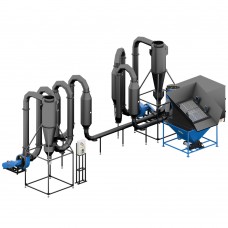
The production process of fuel pellets
According to data collected by the Central Emissions Register of Buildings, more than 400 thousand pellet boilers are registered in Poland. We can assume that the demand for this fuel corresponds to the annual production, estimated at approx. 2 million tons. Due to last year’s turbulence related to the supply and price of pellets, many potential producers, distributors
and users are holding back from purchasing pellet production lines as well as the pellets themselves, explaining
that pellets are too expensive.
What is pellet and what is it made of?
Pellet is a heating fuel made from chemical-free by-products from sawmills
and carpentry workshops. These include sawdust, wood shavings and wood chips originating from both softwood and hardwood processing. Pellet is a granulate whose diameter is usually 6 or 8 millimeters. This pellet size is optimal for the automatic feeding of a heating boiler and ensures clean combustion as well as convenient operation.
Advantages and disadvantages of pellet
There is no doubt that for the end user pellet is an energetically efficient fuel, whose calorific value (19MJ/kg) is slightly lower than the calorific value of coal (23 MJ/kg). From an ecological point of view, it is a renewable fuel that contributes to sustainable development, and for the consumer it means convenience resulting from less involvement in the maintenance and servicing of the heating boiler.
In terms of ecological balance and sustainable development, pellet production is justified when the raw material is wood waste and not raw material obtained as a result of deforestation. Therefore, environmentalists emphasize that whole logs should not be used for pellet production.
Another important aspect perceived by consumers as a disadvantage is the instability of pellet prices in recent years. However, prices should always be viewed from a longer-term perspective.
The pellet production process
The production of this fuel is based on the compression of raw materials such as wood shavings or sawdust.
To produce one ton of pellets, usually 6–8 m3 of raw material is required. The final result depends on physical properties such as moisture content and density.
The first stage in the production process is cleaning the raw material from unwanted contaminants. These may include particles of various metals or stones. Metal and heavy material separators are used for this purpose. In the case of clean raw material, this stage can be omitted. Then, due to the diversity of the raw material in terms of size, it is directed to a hammer mill, where a uniform fraction is obtained.
In the second stage, the raw material undergoes a drying process. Usually, sawdust, shavings and chips have a significantly higher moisture content than required. It can reach up to approx. 40%–50%. After drying, the moisture content of the raw material drops to even 10%, and this parameter determines the quality of the pellet
and its subsequent clean combustion in the boiler.
The next stage is conditioning of the raw material. This usually takes place by adding a small amount of water during the pelletizing process itself; however, some manufacturers
add various supporting agents earlier, such as starch or flour.
The next stage takes place in the pellet mill die itself. The soft raw material is pressed under high pressure into the die holes by means of rollers, and the finished pellet emerging from them is cut to the desired length using knives. During the pelletizing process, at the contact point between the die and the rollers, the temperature ranges from 60°C to 80°C. This causes the lignin contained in the raw material, which is a natural binder, to contribute to the formation and binding of the pellet.
The fifth stage is cooling the final product. The pellet granules cool down in the open air. Cooling can be intensified by additional fans installed on the belt conveyor. During the cooling process, the bonds solidify and become stable. Thanks to this, the pellet retains its shape until the moment of combustion
in a boiler, stove or fireplace.
The last stage is sieving. Dust and improperly compressed pellets are separated
and directed back into the production process, while good pellets are packed into bags or transported to a storage tank/silo as bulk material.
The final product may undergo certification. Depending on ash content, nitrogen compounds
and calorific value as well as moisture content, fuel pellets are divided into 3 quality classes.
A1 class pellets guarantee the highest quality and are mainly offered to individual customers. A2 class pellets are medium-quality pellets and are mainly used in large heating installations. Class B pellets are mainly used in boilers equipped with a self-cleaning burner.
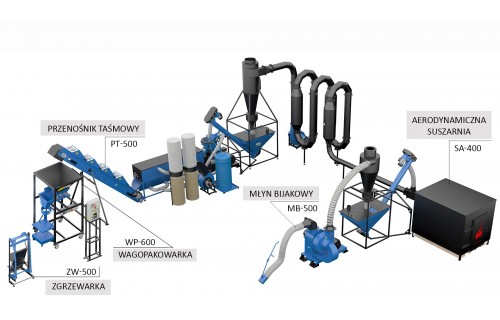
Pellet production line by TechnoMaszBud Sp. z o.o.