Imagine waking up, and outside the window there is a beautiful morning - not bad at all. You put on your slippers and glide toward the kitchen. First of all, coffee - a flat white sprinkled with a pinch of cocoa. Then it’s time for breakfast - cereal with nuts and dried fruit, plus a bread roll with pumpkin seeds, a handful of walnuts for better thinking, and to sweeten the coming day, two squares of milk chocolate…
Hold on, hold on, this is not a lifestyle blog, but a technology one… Exactly. So why all this breakfast talk. I’ll explain in a moment - every product I mentioned in this rather long introduction was, at some stage of production, subjected to… roasting.
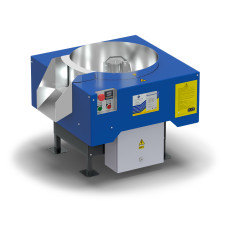
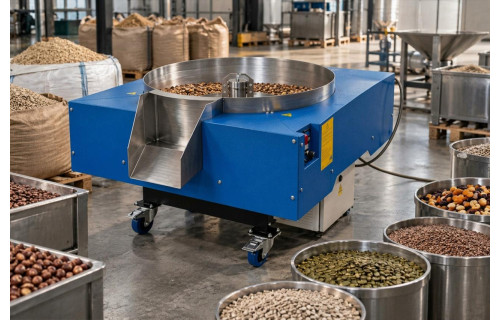
And this is exactly where today’s heroine comes into play - electric roaster.
Its list of applications is truly impressive. All kinds of nuts, seeds, kernels, groats, cereals, cocoa, spices, and even chestnuts or pasta are just some examples.
So let’s find out what lies behind the versatility of electric roasters and how one could work in your business.
Let’s begin.
1. Coffee beans – a classic of the genre
The most obvious use of an electric roaster is, naturally, the coffee bean roasting already mentioned in the introduction. The thermal process makes it possible to bring out the characteristic aroma, taste, and color of the beans. Knowing the enthusiasm and passion of local coffee lovers, I suspect that more than one substantial volume could be written about the secrets of this stage.
We, however, will focus on our field.
From a technological point of view, the ability to precisely control the temperature and to mix the beans evenly is important here.
In a professional roasting facility, process repeatability is of key importance.
2. Nuts and dried fruit
Roasting is also a popular way of processing nuts. An electric roaster can be used, among other things, for processing hazelnuts, walnuts, and other dried fruit.
Under the influence of temperature, nuts acquire a more intense aroma and characteristic taste. Even mixing is also very important here, because it reduces the risk of scorching part of the product.
Such an application may be particularly interesting for nut processing plants, food manufacturers, and companies involved in the production of confectionery products.
3. Sunflower seeds and pumpkin seeds
Another group of products that can be roasted are seeds and kernels. Good examples are sunflower seeds and pumpkin seeds.
As with other products, roasting them makes it possible to obtain a more distinct taste and characteristic aroma. Depending on the needs, the temperature and processing time can be selected accordingly. Even distribution of the raw material by the agitator helps achieve a uniform effect throughout the entire batch - this is important in production aimed at selling a repeatable product.
4. Cereals and groats
What may be less commonly known, an electric roasting machine can also be used for processing cereal grains and various types of groats. The roasting process changes the sensory properties of the raw material, making it possible to obtain a characteristic…nothing new under the sun… aroma and taste.
Are cereals and groats your field? Check whether a roasting machine will let you expand your product range.
5. Cocoa
Another, slightly less popular example, at least in our climate zone. In this case, control of the process conditions is particularly important, because temperature affects the aromatic properties of the product.
6. Spices
Roasting can also be a way to bring out the aroma of selected spices. Heat treatment makes it possible to obtain a more intense, more characteristic smell and taste of the given raw material.
In the case of spices, the ability to set the temperature precisely is particularly important. Individual products may require completely different process parameters. The list of spices suitable for roasting is long; cumin, mustard, or cardamom are the most obvious ones.
7. Chestnuts and other food products
The roasting machine can also be used for processing chestnuts and other food products that require controlled heating and mixing.
It is precisely multifunctionality that distinguishes this type of equipment from machines intended exclusively for one type of product. However, the final process parameters should always be selected according to the properties of the specific raw material and the expected effect.
8. Pasta
Although roasting pasta may seem like an unusual application, it too can be subjected to controlled heat treatment. Thanks to this, an electric roasting machine can find use in more specialized production processes.
In the case of less typical raw materials, it is particularly important to carry out technological trials and select the appropriate temperature, time, and mixing speed.
9. Drying bulk products
An electric roasting machine does not have to be used only for roasting. Thanks to the ability to regulate the temperature in the range from 60 to 280°C, it can also be used for drying selected bulk products.
Lower temperatures allow gentler processing, adapted to the characteristics of a specific raw material. In practice, this means that one machine can perform several functions and be used at different stages of product preparation.
10. Processing raw materials for the needs of various industries
The wide range of applications of electric roasters means that they can find a place in many industries. They are used, among others, by coffee roasters, confectioneries, restaurants, nut processing plants, confectionery industry plants, craft workshops, and other food businesses.
An important advantage is the ability to adapt the machine to the type of raw material being processed. Depending on the needs, the appropriate type of agitator and its rotational speed can be selected. Thanks to this, the machine can be configured with a specific technological process in mind.
What should you pay attention to when choosing a roasting machine?
If the machine is to be used for different products, it is worth paying attention above all to the temperature control range, the mixing method, and the possibility of adjusting the operating parameters.
For example, the ROASTPRO - 10 roasting machine available on our website is characterized by a wide amplitude of achievable temperatures: 60 - 280 degrees Celsius.
The construction of the machine is also important. High-quality stainless steel ensures resistance to corrosion, temperature changes, and mechanical damage. In turn, proper insulation reduces heat loss and increases the machine’s energy efficiency.
It is also worth checking whether the manufacturer offers the possibility of equipment customization. Personal selection of the appropriate agitator and its operating speed (possible when purchasing TechnoMaszBud equipment) can be of great importance in the case of raw materials of different size, weight, or moisture content.
To sum up
An inconspicuous roasting machine is undoubtedly a technological chameleon. Whether it is the compact ROASTPRO-10 or the powerful ROASTPRO-50 , depending on the needs and conditions, this machine can adapt to specific production lines and business sectors. It is precisely the versatility of these machines that makes their purchase rather a profitable investment than a one-time expense. Happy roasting :)