“29,086 measures of barley were received over 37 months. signed: Kushim” - this perhaps not very poetic sentence written in ancient Mesopotamia about 5 thousand years ago is one of the oldest known examples of writing, and the Kushim responsible for the content of that clay tablet is the first accountant in history known to us by name. Why am I writing about this on a blog devoted to technology, energy and agriculture? The reason is quite banal. This archaeological find from the area of present-day Iraq proves something very important - accurate measurement and record-keeping of raw material have been the foundation of business since the dawn of history. However, a modern Kushim would not have to painstakingly count successive measures of barley or pour seeds through a series of clay vessels used for measuring bulk materials. Instead, he could use a modern weighing and bagging machine or bagging scale. And it is precisely these devices that we will take a closer look at today.
Intrigued? Let's begin.
Weighing and bagging machine - what exactly is it?
Starting from the basics, as if for Kushim :)
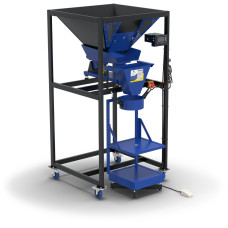
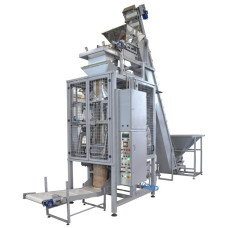
Weighing and bagging machine, also called a bagging scale, is a device designed for dosing, weighing and packaging bulk materials. Its task is to measure out a specific quantity of product and then direct it into prepared packaging. Thanks to the use of a weighing system, a specific portion weight can be set and the entire process can be controlled with appropriate accuracy.
TechnoMaszBud weighing and bagging machines use weighing dispensers that allow measuring out various types of bulk materials. They can be used, among other things, for pellet, feed granules, short-cut pasta, sugar, sunflower seeds or nuts. This means that they are not a solution intended exclusively for one type of production.
Devices of this type can work with both polypropylene bags and film bags, making it possible to adapt the packaging method to the specifics of the product and your own needs.
How does a bagging scale work?
The operating principle is relatively simple. The operator sets the appropriate device parameters, prepares the package and starts the weighing process. The dispenser feeds material into the bag until the set weight is reached. After filling is completed, the operator takes the finished package and can prepare the next one.
In the case of devices from our stable (TMB), we are dealing with a semi-automatic work process. This means that the machine takes over the most important task related to precise dosing and weighing, but the operator still takes part in operating the workstation – among other things, fitting the bag, starting the weighing and collecting the filled package.
This solution makes it possible to combine automation with simple operation. The operator does not have to measure out each portion manually, and the device performs repetitive tasks according to a previously established program.
Precision above all
When packaging bulk materials, accuracy really matters a lot. Too small an amount of product may mean a problem with maintaining the appropriate package weight, while an excess of material may generate unnecessary losses. That is why one of the most important elements of a weighing and bagging machine is the system responsible for weighing.
Weighing and bagging machines and bagging scales work in different measurement ranges, for example, WP-400+ operates in the range from 0.15 to 40 kg. The operator can set the appropriate portion weight depending on the type of product and the adopted packaging method. The device controls the dosing process, and the weighed product can undergo a compliance check against the set parameters and permissible tolerances.
The accuracy and efficiency of work are also influenced by the applied design solutions, including compact pressure sensors and precise dispensing hoppers.
What can a weighing and bagging machine be used for?
Although in the context of our business, including, among other things, the sale of pellet mills and granulators, the natural application of weighing and bagging machines seems to be primarily measuring biofuels in granular form, the capabilities of these devices are much broader. Their use is not limited exclusively to pellet – they can be used for precise dosing and packaging of a wide range of bulk materials.
Weighing and bagging machines can be used for dosing and packaging, among other things:
- pellet,
- feed granules,
- grains and seeds (including barley)
- short-cut pasta,
- sugar,
- sunflower seeds,
- nuts,
- groats,
- construction mixes,
- other dry bulk materials.
It is precisely versatility that is one of the greatest advantages of this solution. A properly selected weighing and bagging machine can be used both on a farm, in a small manufacturing business, and in a larger enterprise.
What happens to the bag after filling?
Simply measuring out the product is not yet the end of the process. The filled bag must be properly closed so that its contents are secured during storage and transport.
To seal bags, you can use an impulse sealer, e.g. ZW-500 model. In combination with a weighing and bagging machine, it makes it possible to create a practical workstation in which the successive stages of preparing the product for sale are organized and carried out efficiently.
This solution is particularly useful wherever repeatability matters – both in terms of product weight and the method of closing the packages.
What should you pay attention to before buying?
The choice of a weighing and bagging machine should not be random. First of all, it is necessary to determine what will be packed and in what quantities. The expected weight of a single bag, the type of packaging, the required capacity and the available space are also important.
It is also worth checking the device in practice. In the case of TechnoMaszBud machines, there is a possibility of testing the selected solution in the company's warehouse hall. This makes it possible to see how the device handles a specific material and whether it meets the needs of a given production.
Such an approach can protect against buying a machine mismatched to the actual working conditions. And after all, that is exactly the point of the slogan „don't get yourself into trouble”.
Signed: Janek from TMB :)