Feed Granulator: What Problems It Helps Solve
Granulators make it possible to solve many problems.
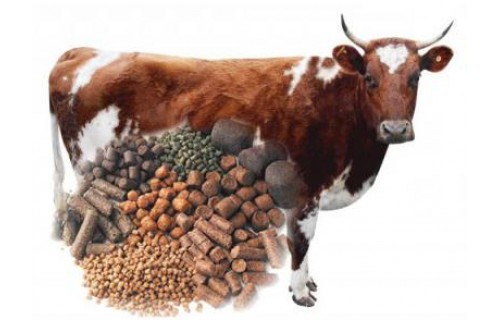
Farmers have also started paying attention to granulators. With this equipment, it became possible to create feed pellets that the animal must consume entirely, without selecting favorite ingredients, thus supplying the body with all the necessary nutrients.
First, we should define the term “granulator.” A granulator is equipment that converts loose raw materials (feed mixtures, sawdust, straw) into pellets. After processing, the ingredients do not lose their nutritional value; on the contrary, they become better. In detail, it looks like this.
For what purpose was the pellet press created? Back in 1930 in the USA, at one of the sawmills, it was discovered that when pressing wood, sawdust releases a sticky substance called lignin. Compressed sawdust and other wood industry waste released significantly more heat during combustion, and their storage was convenient. That is when the idea arose to create a pellet press that would process waste into efficient biofuel that does not emit toxic and chemical elements into the atmosphere. At first, the idea was not taken seriously due to the low cost of gas installations, but over the years and with changes in gas prices, pellets and pellet boilers began to spread at lightning speed.
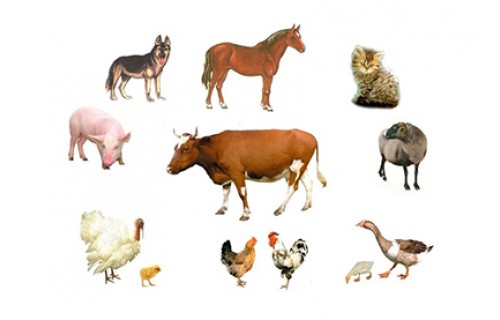
Farmers also began to pay attention to granulators. With this equipment, it became possible to create feed pellets that the animal had to consume entirely, without selecting favorite ingredients, thereby obtaining all the necessary nutrients from it. An important advantage is easier storage and transportation of such feed, as well as the possibility of producing pellets not only for animals but also for poultry.
LET US DIVE INTO THE GRANULATION PROCESS: WHAT HAPPENS TO LOOSE FEED
At the pressing stage, the loose material is subjected to high temperatures and strong compression, as a result of which complex chemical substances break down into simpler ones. For example, starch breaks down into simple sugars that are better and faster absorbed. In addition to these advantages, it can also be noted that the mixture undergoes a disinfection stage; pathogenic microorganisms that cause intestinal infection are eliminated.
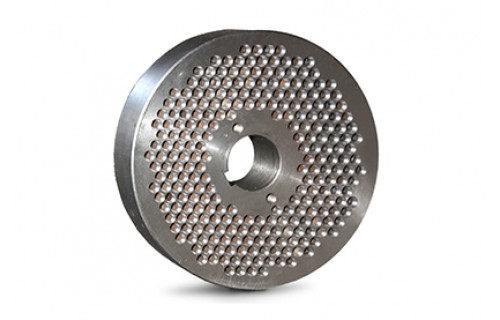
After loading into the hopper, the mixture is evenly fed into the pressing part of the granulator, namely to the rotating die and moving rollers. Then the compressed mixture exits through through-channels (holes). The pellet length is controlled by a special cutting knife installed in the granulator, and the diameter – thanks to different holes in the die. Specialists of the company “TechnoMaszStroj” select the die according to individual needs, taking into account what the client wants to produce.
WHY IS IT MORE PROFITABLE TO BUY A GRANULATOR THAN TO BUY PELLETIZED FEED?
First of all, of course, it is the price, because every time we buy ready-made feed, we overpay by at least 100%.
Secondly, we cannot be sure of the pellet composition, since the manufacturer, in order to reduce the product price, may use some substitutes.
Thirdly, we have the opportunity to optimize the feed according to our own needs.
In the case of purchasing a granulator, we have a guarantee that the animals will receive exactly the ingredients that were loaded into the hopper. We can also be sure of the quality of raw materials. Additionally, the purchase of a granulator pays off very quickly due to the high demand for the finished product.
SPECIFIC FEATURES OF “TechnoMaszBud” GRANULATORS
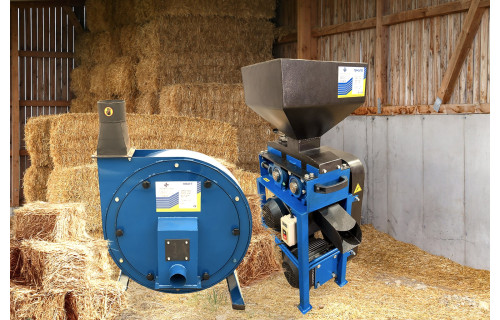
Our specialists manufacture granulators that are fully adapted to market conditions. Namely, these are granulators with low electricity consumption, efficient, universal, and affordable. These are not just words, because our assortment includes models with power from 1.5 kW to 37 kW and capacity from 40 kg/h to 1000 kg/h. It is also always possible to select equipment according to dimensions. We offer compact models that fit on a regular table and are easy to transport. There are also more advanced granulators that can be equipped with dryers, calibrators, conveyors, and humidifiers, which makes it possible to create a small production plant for pellets and feed.
The versatility of our granulators lies in the fact that by changing the die with through-channels, it is possible to produce pellets with a diameter from 2 to 8 mm, which makes it possible to produce feed for cattle, medium-sized animals, rabbits, and poultry. The advantages of pellets have also been appreciated in fish farms: pellets do not soak quickly in water and retain all their nutritional properties in a humid environment.
We also manufacture rollers and all elements for the granulator. Spare parts are always available, so our customers do not have to worry about equipment downtime. The frame and cutting elements are made of stainless steel.
Our company offers the possibility of assembling the granulator independently: each working unit can be purchased separately. There is also a choice of motors. The same granulator can be equipped with a 220 V or 380 V motor, which allows it to be used both in domestic conditions and in production. This is also a useful option for those who already have a frame and other working elements and only lack a motor.
Equipment for pellet production can confidently be called “2 in 1” thanks to the fact that at the output we can obtain either pelletized feed or fuel pellets. Everything depends on what raw materials are loaded into the equipment: feed mixture or sawdust. Recently, pellets from straw, biomass, hay, sunflower husk, rapeseed, reed, grass, etc. have become popular. In short, what remains after harvesting in the field can automatically be converted into biofuel and used to heat a house or outbuildings, a farm, etc.
Many will also be pleased with the information that the equipment is easy to control and some models have inspection windows, which allows observing the process at every stage. To start and operate our granulators, no special training is required: any operator can cope with this task. To learn more, you can call us, and we will tell you the details.