
Granulators for feed by TECHNOMASZBUD. What problems do they help solve?
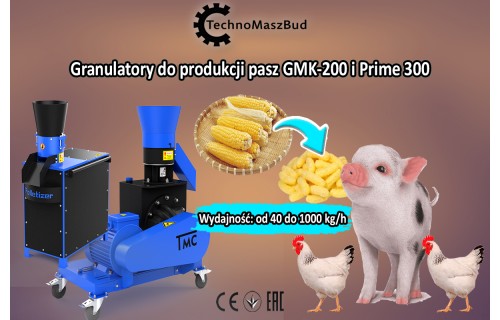
To begin with, let us define the very term „granulator”. It is a device that converts bulk raw materials (feed mixtures, straw, grain, vegetable waste) into granules.
The first granulator was manufactured in the USA in 1911, while the beginning of feed granulation dates back to the 1930s. It was then that research on a larger scale began on the technology of producing feed in granulated form and its application in animal nutrition.
Farmers and breeders in countries such as England, Denmark, the Netherlands and Germany began to pay attention to granulators. With this equipment, they could create feed granules that the animal had to consume entirely, without selecting favorite ingredients, and thus obtaining all the necessary nutritional values from it.
Important advantages of the granulation process are easier storage and transport of feed and the possibility of producing granules not only for animals, but also for poultry. After processing, the ingredients do not lose their nutritional values, but on the contrary, they become better. In detail, it looks like this:
LET US TAKE A CLOSER LOOK AT THE GRANULATION PROCESS: WHAT HAPPENS TO BULK FEED?
At the pressing stage, the bulk material is subjected to high temperatures and strong pressing, as a result of which complex chemical substances break down into simpler ones. For example, starch breaks down into simple sugars that are better and faster absorbed. In addition to these advantages, it can also be noted that the mixture undergoes a disinfection stage, pathogenic microorganisms that cause intestinal infection are removed.
After loading into the hopper, the mixture is evenly fed to the working part of the granulator by means of a feeder, namely onto the die with rollers. Then the pressed mixture exits through through channels (holes). The length of the granules is controlled by a special cutting knife installed in the granulator, and the diameter – thanks to different holes in the die. Specialists from Technomaszbud Sp. z o.o. select the die according to individual needs, taking into account what the customer wants to produce.
WHY IS IT MORE PROFITABLE TO PURCHASE A GRANULATOR THAN TO BUY GRANULATED FEED?
In the case of purchasing a granulator, we have a guarantee that the animals will ultimately receive the ingredients that were loaded into the hopper. One can also be sure of the quality of the raw materials.
Feed produced using Technomaszbud granulators has additional advantages compared to bulk feed:
- longer shelf life due to the destruction of fungi and pathogenic microorganisms in the thermal production process
- higher resistance to moisture
- lower losses during transport and during loading and unloading
- possibility of production depending on needs
To produce 1 ton of feed in granulated form for laying hens, 400 kg of wheat, 400 kg of corn, 150 kg of soybean meal and 50 kg of mineral-vitamin additive are needed. The cost of all ingredients is currently approx. 1300 PLN/ton. Assuming the price of ready-made feed for laying hens at the level of 2140 PLN/ton (according to PASZE-24.PL), we obtain a benefit of approx. 840 PLN per ton of feed in own production. In the case of a „small” farm with 20 thousand hens and assuming that a hen eats on average 150 g of feed daily, the annual feed demand is approx. 1100 tons. With such an amount, the total benefit is approx. 900 thousand PLN per year. This value allows more than covering the costs of electricity and the machine operator. If the prices of raw materials (wheat, corn, soybean meal) are lower, then production will be even more profitable, because the prices of ready-made granulated feed usually do not decrease proportionally.
To produce 1100 tons of feed in granulated form, we dedicate the PRIME series granulator, model 300.
ADVANTAGES AND FEATURES OF KGM/GMK/PRIME SERIES GRANULATORS BY TECHNOMASZBUD
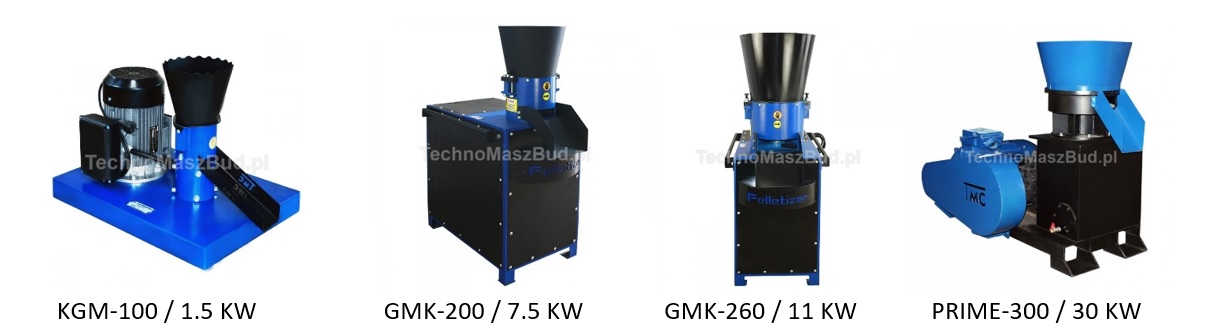
|
Dimensions / Model |
KGM-100 |
GMK-200 |
GMK-260 |
PRIME-300 |
|
Length |
610 mm |
900 mm |
900 mm |
1300 mm |
|
Width |
420 mm |
700 mm |
700 mm |
900 mm |
|
Height |
420 mm |
1400 mm |
1500 mm |
1300 mm |
|
Weight |
45 kg |
160 kg |
250 kg |
650 kg |
|
Main Features |
||||
|
Die hole diameter |
from 2 to 6 mm |
from 2 to 8 mm |
from 2 to 8 mm |
from 2 to 8 mm |
|
Application |
for the production of pelleted feed |
|||
|
Product type |
pellet mill |
pellet mill |
pellet mill |
pellet mill |
|
Drive type |
electric |
electric |
electric |
electric |
|
Capacity |
up to 40 kg |
up to 200 kg/h |
up to 300 kg/h |
700 kg/h |
|
Motor power |
1.5 kW |
7.5 kW |
11 kW |
30 kW |
|
Voltage |
220V/380 V |
380 V |
380 V |
380 V |
|
Roller speed /min |
250 rpm |
250 rpm |
250 rpm |
215 rpm |
|
Die diameter |
100 mm |
205 mm |
259 mm |
300 mm |
|
Additional features |
||||
|
Warranty period |
12 months |
12 months |
12 months |
12 months |
|
Number of rollers |
2 pcs. |
2 pcs. |
2 pcs. |
2 pcs. |
|
Number of knives |
1 pc. |
1 pc. |
1 pc. |
2 pcs. |