Wood or pellet – what to burn?

The heating season in Poland lasts roughly half a year. During this period, most often between October and April, owners of single-family houses and farms not connected to the proverbial “line” face a difficult choice – what to burn? There are many possibilities. Some fuels tempt with efficiency and low price, others with low emissions and ease of acquisition. In this comparison, we will take a closer look at two popular natural fuel materials – wood and pellet.
Wood and pellet – characteristics
Wood is a fuel that probably needs no introduction. It is the oldest fuel material known to humankind, used continuously for hundreds of thousands of years at every latitude. Wood owes its flammability to cellulose – a molecule composed of bonds between carbon, hydrogen and oxygen. There are thousands of tree species, and therefore varieties of wood. Some constitute better, others worse fuel material. All of them, however, grow thanks to photosynthesis, which requires carbon dioxide and sunlight. In the combustion process, wood releases the energy that the tree absorbed from the Sun. Like almost any other fuel on Earth, wood is merely a carrier of solar energy.
Pellet is a wood-based fuel in the form of granules. It is produced from wood waste, shavings, sawdust, straw cuttings or sunflower husks. The initial material is fed into a device called a pellet mill, where the biomass is compressed and processed, as a result of which cylindrical granules not exceeding 1 cm in length are formed. The mass of the finished pellet amounts to about 70 percent of the initial biomass.
Efficiency
The calorific value of wood varies depending on its moisture content. Another key feature is the density of the wood. It is worth remembering that, in general, deciduous trees are denser than conifers, which is why they are better suited as fuel. For freshly cut wood, the calorific value oscillates around 7.2 MJ/kg. Wood after a year of storage reaches a result of approx. 12.2 MJ/kg. For well-dried wood, this figure may amount to 14.4 MJ/kg.
The calorific value of good quality pellet is 19 MJ/kg, i.e. 30 percent more than for the best class of wood. This may seem paradoxical, considering the fact that the basis for pellet production is usually wood. In the process of pelletizing biomass, however, the granulate gains energy value compared to the initial material through drying and compression. Of course, this indicator may vary depending on the type of pellet: it will be slightly different for sawdust pellet and different for sunflower husk pellet.
Impact on the environment
From the point of view of the CO2 cycle in nature, both wood and pellet are fuels with a zero carbon balance. During their combustion, approximately as much carbon dioxide is released into the atmosphere as the tree from which the wood (or wood-based fuel) originates absorbed from the atmosphere during its growth period. Burning wood can be considered ecological, as long as the origin of our fuel is known to us and legal.
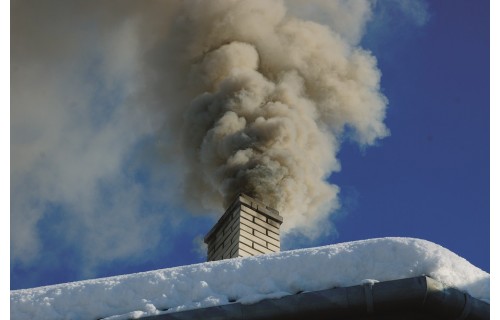
When it comes to the emission of harmful substances into the atmosphere, the situation looks slightly worse. Burning wood is harmful because the smoke produced in this process is a mixture of gases and fine particles (also called particulate pollution, suspended dust or PM). In addition, smoke from burning wood contains benzene, formaldehyde and acrolein. The most dangerous components of smoke for health are fine particles, also called fine particulate matter or PM 2.5. They intensify symptoms in people suffering from asthma, increase the risk of heart attacks and may cause chronic lung diseases. It is estimated that burning 15 kg of wood generates as much PM 2.5 in the air as burning 7,500 cigarettes.
In the case of pellet, the harmfulness of gases released into the atmosphere largely depends on the quality of the fuel. Good pellet should burn in 99 percent and leave behind small amounts of ash and smoke. Smoke from pellet, similarly to that emitted during wood combustion, contains fine particles dangerous to health as well as formaldehyde and acrolein formed as a result of lignin combustion, however during granulate combustion, smoke emission is definitely lower than during wood combustion. Pellet, thanks to the compression process, is definitely less moist and sticky than raw wood, and therefore produces significantly less smoke.
The situation becomes dangerous when wood waste with the addition of glues, varnishes or binders was used for pellet production. If we put parts of old furniture or fragments of plywood or OSB boards into the pellet mill, we will obtain contaminated granulate, the combustion of which will release fumes of melted glue or varnish dangerous to health. For this reason, it is worth ensuring a proven source of fuel or responsible pellet production, even for one’s own use.
It is worth noting that pellet burns in a tightly closed boiler equipped with a special pellet burner, while wood is often burned in open fireplaces inside the house. In this respect, people burning wood may be more exposed to harmful substances.
It is worth remembering, however, that in terms of air pollution both of these fuels are definitely less harmful than popular fossil fuels – coal or heating oil.
Learn more on this topic: Is heating pellet ecological?
Wood or pellet – what is more profitable?
Comparing the economic advantages of these two fuel materials is problematic, because both of these materials can be obtained outside the traditional circulation. There are many ways to obtain wood: it can be bought at a timber yard, repurchased from organizations responsible for forest logging or obtained from other sources. The price of wood at a timber yard ranges between PLN 200 and 700 per cubic meter, depending on the tree species and storage period. Wood prices from forest districts in 2023 ranged between PLN 124 and 282 per cubic meter.
In the case of pellet, the issue is also complex. The price of pellet is about PLN 1000 per ton (let us add here that about 20 kg of granulate is used to heat 100 m² of area for one day). A cost-effective alternative is independent pellet production from biomass, wood waste or husks. For farms generating large amounts of wood dust, sawdust, straw cuttings or sunflower husks, such a solution is an attractive form of self-sufficiency. Thanks to a pellet mill, it is possible to produce valuable fuel from waste that would otherwise have to be disposed of.
For farms producing their own fuel, a one-time expense when purchasing a pellet mill is an investment that will pay off after a short time. Own pellet production also allows independence from supply chains or speculation on fuel prices.
Summary
Heating with pellet seems to be an improved version of heating with wood. Processing biomass in a pellet mill allows the use of the full energy potential of plant-based fuel. Wood will always enjoy the status of the most elegant fuel. It is irreplaceable in elegant fireplaces, where it pleases the eye with its bright flame, or in smokehouses or restaurants, where its smoke enhances the taste of traditional dishes. It has cultural value that no substitute threatens. However, in a tightly closed boiler, where more than a pleasant smell efficiency and reliability count, pellet is the clear favorite. It is a fuel created with energy delivery in mind, which in this field remains unrivaled.