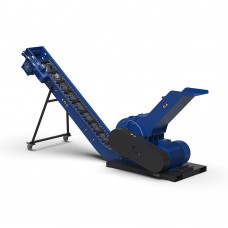
Branch and wood chippers – types and their applications

Wood chippers, as the name suggests, are machines used for shredding wood. On the one hand, we feed larger branches and pieces of wood into the device, the machine does its job, and we obtain fuel material of the desired dimensions. It sounds trivially simple, but as is often the case, the matter is somewhat more complex.
Types of chippers and their applications
The first criterion for dividing chippers into individual types is their power supply. We distinguish gasoline and electric chippers. Depending on whether we will use them near the farm or, for example, in an orchard or forest, it is worth choosing a different type of drive.
Gasoline chippers
As the name suggests, they are powered by gasoline. This allows for independence from electricity and work anywhere. Gasoline chippers prove useful in the field: during logging, in nurseries located far from the farm.
Electric chippers
The electric version of the drive will perform perfectly as household equipment, more economical in operation, but limited by the length of the extension cord.
Chippers are also divided according to their operating method:
Drum chipper
In this chipper, the wood shredding mechanism consists of two rollers equipped with blades. The rollers rotate in opposite directions, enabling the shredding of large blocks of wood into smaller chips or shavings. The product of this process is biomass, which is perfectly suitable for the production of briquette or high-energy and efficient pellet.
To learn more about independent pellet production click here.
Barrel chipper
In this type of chipper, the cutting mechanism is based on the rotary movement of a single cylinder with blades mounted on the outside. The wood to be cut is fed through an opening, and then the drum rotating around its own axis shreds it into small pieces. Depending on the settings, we obtain material in the form of sawdust, chips or dust. In our offer you will also find barrel chippers.
Disc chipper
The last type of chipper is the disc chipper. Smaller fragments of wood or branches are fed into this device, which are turned into chips or sawdust by large rotating discs. Similarly to the drum and barrel chippers, blade adjustment is possible – in this way the size or granularity of the final product can be changed.
Thanks to the possibility of adjustment and introducing your own settings, these devices, despite significant structural differences, fulfill quite similar functions and can often be used interchangeably.
Chipper only for professionals?
Chippers are mainly associated with logging work and may be considered specialist equipment for lumberjacks. In reality, however, any farm or workshop generating large amounts of wood waste can successfully use a chipper and thus minimize wasted material that would otherwise have to be disposed of. Also check: waste shredder.
What benefits does using a chipper provide?
Wood waste can be processed into chips, and these have a number of practical applications. They can be useful in gardening as material for fertilizing beds or covering garden or park paths. Chips are also used as insulation or as material for the production of wood-based boards – e.g. particle boards.
In addition, wood chips constitute an ideal base for the production of high-energy, ecological fuel materials – such as pellet or briquette.
Chips can also simply be sold. Their price oscillates around 100 PLN for a 15-kilogram bag. In this way, one can get rid of waste and even earn extra money on it, which is undoubtedly an attractive solution.
In summary:
Wood chippers are relatively simple devices that can significantly change the efficiency of working with wood waste. Investment in this type of equipment fits into the increasingly popular “zero waste” philosophy, i.e. a style of work focused on minimizing the waste of resources. A wood chipper allows you to use one hundred percent of the material at your disposal and ultimately save money and resources.