Valuable waste – a short guide on how to use raw materials

Regardless of whether you run a small workshop, a processing plant, a sawmill or a farm – one thing is certain: your work generates waste. Its removal and disposal is an unpleasant and often costly obligation, burdened with regulations that are difficult to meet. Thoughtful waste management can, however, make it possible to save a lot on proverbial “trash” and even… earn money.
Let’s take a closer look at it.
How to turn waste into fuel? – biomass fuel production
Biomass – what is it?
Biomass is – in short – biodegradable agricultural production waste of plant or animal origin. In practice, this means all kinds of cuttings, peelings, shavings, sawdust and similar residues from processing. This type of waste has high energy potential, which can be released at relatively low cost. This is because all kinds of plants absorb energy from the Sun during their growth. In the combustion process, this energy can be released.
Types of biomass fuels
Briquettes
One of the simplest ways to utilize biomass is briquetting. This process involves grinding and then compressing natural waste. The device necessary for this purpose is a briquetting machine. Briquette production consists of generating high pressure inside the briquetting machine, which binds the material particles together, creating durable fuel briquettes that are easy to store and transport.
The finished fuel most often takes the form of small rectangular blocks. Materials suitable for briquette production include: sawdust, straw, leaves, grass, sawmill waste, grain husks, plant stems, unused parts of plants, fruits or vegetables. The calorific value of briquettes may vary depending on the type of biomass, material moisture and processing method. The most energy-efficient – sawdust briquette – has a performance of 17 - 19 MJ/kg.
Briquettes are quite a universal fuel in terms of the equipment required for their use. They achieve the best efficiency in biomass boilers, but they also burn without problems in universal boilers, coal stoves with adjustable air supply or in industrial boilers. Less often, but also successfully, they are burned in fireplaces or so-called “goat stoves”.
Pellet
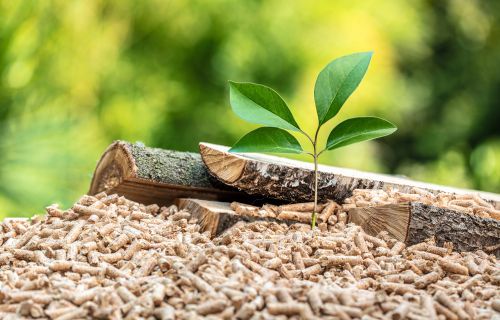
A more specialized and balanced type of fuel produced from biomass is pellet. This type of fuel is mainly made from wood-based waste – all kinds of shavings, sawdust, wood chips or branches previously processed through a wood chipper. A slightly narrower range of possibilities compared to briquettes also translates into numerous advantages of pellets – primarily efficiency and low production of smoke and ash. Good quality pellets have a calorific value of 18 - 20 MJ/kg.
Pellet production takes place inside a machine called a pellet mill. Similarly to briquetting, the raw material is ground and then compressed under high pressure. Thanks to this, no artificial binder is needed in the process.
Finished pellets take the form of cylindrical granules with a diameter usually not exceeding 1.5 cm.
This loose form facilitates transport and, above all, fuel dosing, especially in automated boilers equipped with a screw feeder. Pellets are intended for use in special boilers equipped with a pellet burner. It burns producing small amounts of smoke and ash, as it is less moist than wood or mixed briquettes.
Pellet is a modern heating solution that works perfectly in single-family houses. A properly configured pellet boiler allows you to use the maximum energy potential of the fuel, and increasingly popular smart solutions facilitate automatic pellet dosing, even remotely – using a smartphone.
Biomass fuel production – profitable and ecological
The advantages of biomass fuel production can be multiplied.
Biomass fuel production is an ecological solution, because biomass, unlike fossil fuels, absorbs carbon dioxide (CO₂) during plant growth and releases it back into the atmosphere during combustion. For this reason, the carbon cycle of biomass is almost neutral, which helps reduce overall greenhouse gas emissions.
Additionally, biomass is a renewable energy source, because plants can be grown in a short time, which makes biomass fuel production sustainable and does not deplete natural resources. The production of such fuels also allows the use of agricultural, forestry or industrial waste. In this way, waste can be prevented – something none of us likes.
Producing your own fuel can also lead to savings and, in the case of overproduction, even profit. It is worth remembering, however, that in order to legally sell biomass fuel, the producer is required to meet certain legal requirements, including often obtaining appropriate permits and complying with quality standards.