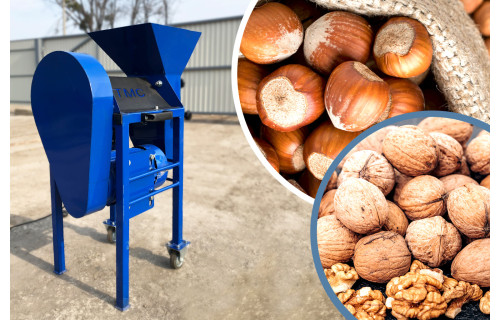
Almost everyone likes to crunch them, and yet the role of a snack is only the beginning! Walnuts are exceptionally versatile: they are popular nuts, additions to baked goods and sweets, salads, cheeses, and savory dishes. In addition, they constitute a raw material for high-quality oil, used for culinary purposes and for the production of natural cosmetics.
The demand for walnuts is very high: they are bought by both individual customers and small enterprises, such as restaurants, confectioneries, bakeries, ice cream shops, artisan oil presses, or cosmetics manufactures, but also large plants specializing in the processing and distribution of nuts and large factories from the food industry, with nationwide and international reach. Polish walnuts are also valued by foreign consumers and therefore exported to Germany and other European Union countries.
All this means that in Poland the demand for walnuts exceeds the supply! Because domestic harvests do not cover national demand, we import large quantities of this raw material, among others from Ukraine, Chile, the USA, and Turkey. It is time to change that – walnut cultivation is an idea for a crunchy business! It is possible to earn from it both in the case of large-area plantations and home cultivation.
Walnut cultivation – an alternative to a traditional orchard
A walnut orchard requires patience, but it can bear fruit for many decades – the condition is proper site selection. Due to the late flowering date, it avoids the problem of spring frosts destroying the flowers of “typical” fruit trees. It produces an extensive root system, to which older trees owe their excellent drought resistance. Irrigation is mainly needed in the first year after planting.
Walnut trees do not tolerate frost pockets and waterlogged areas, but they do well on slopes. They require deep, permeable, fertile soils with a neutral or slightly alkaline reaction (pH 6.5-7.5). They are able to adapt to lower-quality soils, however careful preparation of the site for cultivation will translate into much higher yields.
It is recommended to enrich the soil with green manure, which will turn into fertile humus, and, if necessary, to deacidify it by liming carried out at least 3-4 months before the planned planting. The soil should be deeply loosened by ploughing or discing. At the same time, it is worth enriching it with phosphorus and potassium fertilizers. A very good solution is also the use of manure, preferably already in the autumn of the year preceding planting.
Establishing a walnut plantation requires the purchase of grafted seedlings. There is no point in growing walnuts from seed! Although walnuts germinate very easily, and the seedlings are characterized by vigorous growth, they set their first fruit only after 8-15 years! Meanwhile, grafted walnut trees begin fruiting much earlier, in the 2nd-3rd year after planting.
Initially, yields are small, but an 8-20-year-old walnut plantation established from grafted seedlings already makes it possible to obtain 1-2 tonnes of walnuts annually. In the case of older trees, the yield may increase to over 3 tonnes per hectare.
A walnut tree several years old, under optimal conditions, bears 15-20 kg of walnuts annually, therefore establishing a walnut orchard also makes sense in the case of smaller areas, as a source of additional income for the farm. Walnuts grow vigorously and are long-lived; under optimal conditions they bear abundant crops even at the age of 100-150 years! In many farms, as well as in some city gardens, one can encounter venerable specimens with a crown diameter of more than a dozen metres, bearing 50-80 kg of walnuts every year.
Walnut varieties for commercial and home cultivation. Which walnut variety to choose?
Another issue is the selection of walnut varieties resistant to frost and diseases (especially anthracnose), bearing abundantly, and also characterized by features desired by consumers. In Poland, in private gardens, varieties with large fruit, thin shells, and a large, light kernel, such as the ‘Jacek’ variety series and ‘Milotai’, enjoy unfading popularity. In commercial orchards, varieties with smaller fruit are often planted, such as ‘Broadview’, ‘Mars’, ‘Lake’, and ‘Lublin’. They are easier to dry and less prone to cracking during mechanical harvesting. In turn, in private gardens, varieties with pink flesh, such as ‘Czerwony Późny’, as well as dwarf ones, e.g. ‘Albi’ or ‘Leopold’, can sometimes be found.
Walnut trees grow vigorously, and the vigour depends on the variety. The optimal planting spacing is from 8 x 8 m in the case of less vigorous varieties to 10 x 10 m for vigorous varieties. This means that from 100 to 150 seedlings should be purchased per hectare of walnut orchard. In intensive orchards, walnut seedlings are sometimes planted at smaller spacing, e.g. 8 x 5 m, that is at a density of approx. 250 pcs/ha. This makes it possible to achieve higher yields in the first years after the beginning of fruiting, however after some time it entails the need to cut down every second tree when their crowns become excessively overgrown.
How much can you earn from walnuts?
The potential profits from walnut cultivation depend primarily on the form in which the raw material will be sold. Whole walnuts, in shells, reach wholesale prices in the range of 5-10 PLN/kg. Large-fruited varieties are usually valued more highly.
Edible kernels constitute on average approx. 50% of the weight of whole walnuts – these are what buyers want. After cracking and shelling the price of the wa
lnuts soars! The highest prices are for whole, light halves, the so-called “butterflies”. If their share is very high, the value of the premium-class raw material increases to approx. 35 PLN/kg. A higher price can be negotiated in the case of smaller buyers targeting goods of the best quality, e.g. restaurateurs.
Mix - that is a mixture of halves and crushed walnuts - is much cheaper: its prices fluctuate around 20-25 PLN. It is used mainly for processing purposes, among others in confectionery factories. It also works perfectly as a raw material for pressing walnut oil.
Of course, walnuts do not have to be cracked by hand! Professional nut crackers work much faster than a traditional “grandpa”, while handling the valuable kernel more gently. A large selection of models makes it possible to choose a device adapted to the scale of activity and the quality requirements of the raw material.
- For smaller farms, catering businesses, and manufactures operating in the food industry, a compact nut cracker mounted on a bucket will be an excellent choice.
- In the case of wholesale quantities of raw material, it is worth investing in high-performance models, such as the walnut cracker GRK-300, with a capacity of as much as 300 kg/h. Despite the dizzying pace of work, it makes it possible to obtain up to 70% whole walnut halves.
- In terms of operating precision, the innovative walnut cracker PRK-2 is unmatched. This is definitely the best solution when the highest quality of raw material is the priority. This model cracks walnuts individually, crushing only the shell and leaving the kernel intact.
However, by far the most can be earned from walnuts by pressing oil from them. In this way, we can earn as much as 60-70 PLN per kilogram of raw material!
Walnut oil – a recipe for additional income
Walnuts are one of the most efficient sources of vegetable fats. Their kernels contain up to 60-70% oil! With the help of a professional screw press more than 500 ml of walnut oil can be pressed from one kilogram of shelled walnuts, that is “liquid gold”. And this is almost literal: pressing oil from walnuts is a golden business! Prices per litre of walnut oil are above 100 PLN per litre, and in the case of smaller bottles they are sometimes even three times higher!
Cold-pressed walnut oil is valued by connoisseurs for its exceptional nutty taste, characteristic aroma, and thick consistency. Its health benefits are at least equally important. Therefore, it is worth choosing a press that presses cold. It is characterized by an extremely high concentration of polyunsaturated fatty acids (Omega-3 and Omega-6), and is also abundant in vitamins E and A. Its consumption supports the nervous system, has anti-inflammatory and anti-atherosclerotic effects, lowers blood pressure and the level of “bad” cholesterol.
Walnut oil is also used in cosmetics. It counteracts skin ageing, strengthens nails, nourishes hair, and gives it shine. It is added to luxury facial care products, body creams, and hair balms.
Is walnut cultivation profitable?
The profitability of walnut cultivation depends on a well-thought-out business plan. The selection of a site adapted to the requirements of this species and the purchase of seedlings of proven varieties are of key importance. There will always be demand for walnuts, because so far domestic production covers only a fraction of the demand. However, the price that can be obtained for them depends on the form and quality of the raw material. “Butterflies” are several times more expensive than whole walnuts, but even so they have no chance of competing with expensive walnut oil.
The climate is getting warmer, so walnut trees are beginning to feel in Poland as if they were in their native Italy. In terms of resistance to drought and heat, they leave classic fruit trees far behind. At the same time, consumer tastes are changing: together with the fashion for a healthy lifestyle, the popularity of walnuts will probably increase even more.
Frequently asked questions about walnut cultivation (FAQ)
How long after planting does a walnut tree bear fruit?
The age at which a walnut tree reaches fruiting maturity depends on whether it was grown from seed or by grafting. Walnut seedlings bear their first fruit only at the age of 8-15! Meanwhile, trees produced by grafting a variety onto a rootstock bear fruit as early as the 2nd-3rd year of cultivation.
How fast does walnut grow?
Walnuts are the fastest-growing fruit trees cultivated in Poland. The growth rate is particularly intensive in young plants. With age, growth gradually slows down. Ultimately, walnut trees reach over 20 m in height and produce a spreading crown with a diameter of as much as more than a dozen metres.
Does walnut need a pollinator?
Most popular walnut varieties are partially self-pollinating. Such trees set fruit even when planted singly, however the presence of a second walnut nearby significantly increases the abundance of their fruiting. Seedlings and botanical forms of this species are generally cross-pollinated: they produce male and female flowers on the same tree, but at different times, which excludes self-fertilization.
How to prepare the soil for walnut?
The soil for walnut cultivation should be fertile, deeply loosened, and have a neutral or slightly alkaline reaction. Acidic soils predominate in Poland, therefore liming is the key treatment. Note: deacidification should be carried out at least 3 months before planting! Before establishing the plantation, deep ploughing-in of green manure and phosphorus and potassium fertilizers is also recommended.
Does walnut need to be pruned?
Pruning walnuts is important above all in the first years of cultivation, at the crown-forming stage. A freely growing walnut develops a spreading, multi-leader crown set on a short trunk. Such a tree will work well in a large garden, however on commercial plantations better results are achieved by training walnuts as single-leader trees, with a central leader crown. Regardless of the training method, it is necessary to remove branches emerging from the trunk at too close a distance from one another, which will turn into future scaffold branches. Sanitary pruning is also recommended, that is removing broken, damaged, dead branches or those with symptoms of diseases, as well as thinning (removing branches that excessively thicken the crown).
When to prune walnut?
On commercial plantations, the main pruning of walnuts is carried out at the turn of May and June, when sap circulation slows down and the rate of wound healing is very fast, which limits the risk of pathogens penetrating them. The early spring date is not recommended due to the intense outflow of sap (the walnut “cries” from pruning wounds). Smaller cuts can also be made in summer, until the end of August.
How much does a kilogram of walnuts cost at a buying point?
The price that can be obtained for a kilogram of walnuts depends mainly on whether they are whole or shelled. Walnuts in shells are purchased at 5-10 PLN, meanwhile after cracking their price increases to 20-25 PLN in the case of crushed raw material, and even 35 PLN in the case of a large share of whole, light halves (the so-called butterflies).
Is walnut suitable for wood chips?
Walnut is suitable for wood chips, however their use is limited. Branches shredded with a wood chipper can be successfully used for fuel purposes. Walnut wood is particularly valued by smokers: its smoke gives meats and cheeses a nutty aftertaste and aroma, and moreover colours them golden. Walnut chips are not suitable, however, for mulching soil in the garden or orchard: they contain juglone, a compound harmful to other plants. Its content drops to a safe level only after long-term composting.
Which press for pressing oil from walnuts?
For pressing oil from walnuts at home or in a small oil mill, the multifunctional screw press UM-200 is perfectly suitable. With its help, approx. 500 ml of high-quality walnut oil can be squeezed from a kilogram of walnuts without shells. If production on a larger scale is planned, it is worth investing in the more efficient WT-150 DUO expeller model, which is able to process up to 300 kg of raw material per hour. An alternative for medium-sized enterprises and manufactures is the compact WT-150 oil press. All three expeller models are multifunctional: with their help, cold-pressed oil can be pressed not only from walnuts, but also from many other raw materials, e.g. black cumin, sunflower, hazelnut, or sesame.