Bryquettes from biomass without secrets - what are you really putting into your stove?
Briquettes - it might seem difficult to find a less mysterious product.
Anyone who has ever spent a May weekend at allotment gardens has undoubtedly encountered them. As is often the case, however - the matter is a bit more complex, and the black, oval coals we use to light a grill are just one representative of the great briquette family.
The term briquette refers to all fuel materials created as a result of compressing previously shredded raw materials. They differ in composition, calorific value, ash content, and even intended use. Describing them all would probably require an entire book.
In today’s article, we will focus on biomass briquettes, which, apart from recreational use, constitute a profitable and sustainable source of energy.
1. Wood briquettes (wooden, chip briquettes)
A popular type of briquette, simple to produce and available in retail trade in almost every construction supermarket, is wood briquette, also called wood chip briquette or sawdust briquette.
Production of wood briquettes
The production of wood briquettes is based on grinding and compressing wood waste.
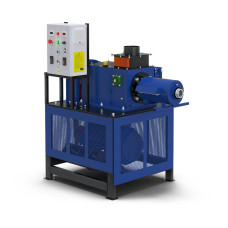
This process takes place inside a machine called a briquetting machine. Before introducing wood into the device, it should be pre-ground, for example using a wood chipper.
The shredded wood is subjected to high temperatures generated by friction created by the briquetting machine mechanism.
Under the influence of heat, the wood releases natural lignin, which binds the wood particles together.
Such a heated wooden mass is easily pressed into the desired shape.
After cooling, the wood briquette becomes a compact, dense block or cylinder.
The finished briquette may weigh up to 30% less than the original raw material - this results from water evaporation during the extrusion process.
Wood briquette is relatively simple to produce. It is an alternative form of obtaining fuel, especially for workshops or farms generating large amounts of wood waste.
For businesses in the sawmill industry, purchasing a briquetting machine may constitute a profitable investment in energy independence and even a source of potential income.
Applications of wood briquettes
Wood briquettes are commonly used as ecological fuel for heating homes in furnaces and solid fuel boilers.
In recent years, along with growing user awareness, wood briquettes have become a popular fuel for recreational fireplaces.
Thanks to them, lovers of live fire can enjoy a warm, blazing flame while avoiding unpleasant, irritating smoke.
This is guaranteed by the low water content in the briquette - it and other liquid substances contained in wood are responsible for the gray, unhealthy fumes.
At this point, it is worth noting that in subsidy programs for ecological heating installations, such as “Clean Air”, heating a fireplace with biomass briquettes is a condition for positive consideration of the application.
Quality and environmental impact of wood briquettes
The calorific value of wood briquettes ranges from 15 - 19 MJ/kg, depending on the species and quality of wood briquetting.
Hardwood (e.g. oak, beech) has a higher calorific value than softwood (e.g. pine).
Wood briquette is considered a carbon-neutral fuel because during combustion it releases approximately the same amount of carbon dioxide that the tree used in its composition absorbed during growth.
Burning wood briquettes causes the release into the atmosphere of the same particles emitted by burning wood - the smoke contains a mixture of gases and fine solid particles, also known as suspended particulate matter or PM.
The difference, however, lies in the scale. Good quality briquette burns even in 98%, emitting negligible amounts of smoke and ash.
Burning wood briquettes is therefore healthier for our lungs than burning untreated wood. This is important information for owners of home fireplaces who care about the health of their loved ones.
A factor that can significantly worsen briquette quality is the use of varnished or glued wood in its production. Any chemicals coating the wood may generate toxic fumes when in contact with fire.
Attention should be paid to the “cleanliness” of the briquetted wood.
2. Briquettes from agricultural waste
A real game-changer in the field of bio-waste recycling is biomass briquette, or more precisely - briquette made from agricultural waste.
As its name suggests, it is a fuel that allows plant residues and leftovers from processing operations to be reintroduced into circulation.
Production of briquettes from agricultural waste
The production process of briquettes from agricultural waste proceeds similarly to that of wood – it involves shredding dry material and then compressing it under high pressure, most often without the use of binding additives.
During compaction, heat is generated, which softens plant structures, and the lignin contained in some plant residues (e.g. husks or straw) may partially act as a natural binder.
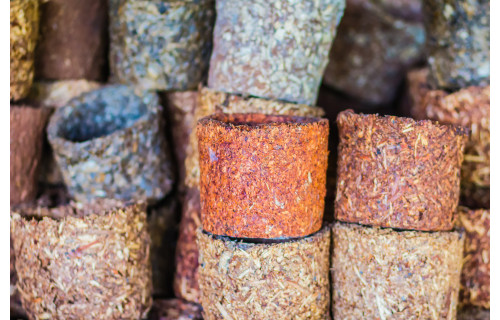
Unlike wood briquette, briquette made from straw or sunflower husks may have a more porous structure and slightly lower density. Depending on the raw material used, the finished briquette may take the form of cylinders, bricks, or irregular blocks. The final weight is also lighter than the initial weight due to moisture evaporation during pressing.
Thanks to the availability of raw materials, agricultural briquettes are a particularly attractive solution for rural farms, agricultural processing plants, and individual farmers, who can produce fuel themselves from their own waste. For larger farms, investing in a simple briquetting machine may mean significant savings on heating and increased energy independence.
Apart from waste traditionally associated with biofuel production (nut shells, hay etc.), less obvious processing residues may also be converted into fuel, such as fruit pulp, coffee or tea grounds, weeds, residues from oil production, or paper, cardboard, and broadly understood waste paper.
Applications of briquettes from agricultural waste
Briquettes from agricultural waste are used primarily in biomass boilers, furnaces adapted to plant fuels, and simple utility furnaces.
They are less commonly used in household fireplaces (due to the risk of clinker formation and a higher ash level). More and more people use them in heating systems in rural areas, as well as in the agricultural and food industries.
High availability and low cost make briquettes made from straw or husks one of the most economical heat sources.
It is also a good way to ecologically manage agricultural waste, which otherwise could be burned in an uncontrolled manner or disposed of without energy recovery.
Quality and environmental impact of agricultural briquettes
The calorific value of briquettes made from agricultural waste depends on the material used – on average it ranges from 14–18 MJ/kg.
Briquettes made from more “noble” waste, such as husks or shells, will be more similar in quality to wood briquettes, while those made from slightly less combustible waste may have lower calorific values.
The ash content in agricultural biomass is higher than in wood – on average 3–7%, which may require more frequent cleaning of furnaces.
Some raw materials (especially straw) also tend to form so-called clinkers, which means not every boiler can handle them. Therefore, it is worth using agricultural briquettes in devices adapted to low-quality biomass.
From an ecological perspective, briquettes from agricultural waste are considered a carbon-neutral fuel, similarly to wood briquettes.
Their combustion releases as much CO₂ as the plants managed to absorb during growth, which means they do not increase the overall greenhouse gas emission balance.
Although smoke from agricultural biomass may contain more particulates than that from wood, modern heating devices make it possible to minimize emissions and achieve clean, almost smokeless combustion, using even 90–95% of the material.
For many users, especially in rural areas, it is a cheap, local, and renewable alternative to coal and gas.
In the case of briquettes from waste the risk of direct exposure to harmful particles is lower because this type of fuel is not used in open recreational fireplaces.
3. Mixed briquettes
The distinction mentioned above between wood briquettes and agricultural briquettes is fluid, and briquette manufacturers can successfully combine different types of biomass.
Agricultural waste, wood waste, or processing residues may successfully form a composite briquette. In the production of mixed briquettes, the proportion of wood to other types of biomass will have a key impact on fuel properties. The rule is quite simple: the more pure wood, the higher the briquette quality.
4. Briquettes - super fuels
As can be seen from the examples above, the process of briquetting various raw materials directly leads to an improvement in their combustion parameters.
In this sense, a briquette made from a given raw material is its improved super-version.
It is no wonder that the briquette family is constantly growing, and in different parts of the world, depending on available raw materials, people experiment with new methods of improving the combustion quality of various natural wastes.
A close cousin of classically understood briquettes is pellet - granulated fuel produced from various types of biomass, most often wood-derived.
To learn more about pellets, check our other text devoted to this topic.