Table of contents
The entry into force of the deposit return system in Poland is one of the biggest logistical and environmental revolutions of recent years. The new regulations impose specific obligations on retail, distributors, and waste management facilities. Empty PET bottles, aluminum cans, and reusable glass packaging will start flowing into return points in tens of thousands of units per day.
For store and warehouse owners, one question becomes crucial: how to control the rapidly growing volume of waste while maintaining cleanliness, free space, and business profitability?
At TechnoMaszBud – as a trusted partner of „working people” – we understand these challenges perfectly. We offer reliable and efficient equipment such as industrial crushers, balers, screw compactors, and automated recycling and sorting lines, which make it possible to reduce transport and storage costs by as much as 70–90%.
Here is a comprehensive guide on how to adapt your business to the requirements of the deposit return system and turn new obligations into improved logistics processes, and even additional profit.
1. Obligations of stores in the deposit return system – a space and logistics challenge
The regulations defining the obligations of stores in the deposit return system clearly impose on retail outlets with an area of more than 200 m² the obligation to collect empty deposit-covered packaging and refund the deposit to customers. Smaller outlets (the so-called deposit return system - small stores) may join the system voluntarily, but for many of them this is a condition for maintaining competitiveness by introducing a convenience for customers. If a smaller store does not decide to introduce a packaging collection system, the Ministry of Climate and Environment imposes an obligation to conclude an agreement with an operator.
Regardless of the size of the point, the basic problem becomes the lack of space in the backroom. Uncompressed PET bottles or beverage cans are 90% „containers filled with air.” Storing them loose leads to:
- Rapid blockage of warehouses and traffic routes.
- High transport costs (paying to transport air).
- The risk of disorder and difficulties in maintaining sanitary requirements.
- Violation of health and safety and fire regulations, and therefore a fire risk.
2. Deposit return system: Should bottles and cans be crushed? The technical and practical answer
Among entrepreneurs and consumers, the question often arises: deposit return system – should bottles be crushed?
At the consumer collection point (e.g. when a customer inserts packaging into an automatic reverse vending machine), the packaging must have an undamaged barcode so that the system can verify the deposit. However, after recording and accepting the packaging in the store backroom or at the collection point, its immediate crushing becomes virtually a necessity!
In the case of both PET bottles and aluminum cans, direct crushing of deposit packaging in the backroom is the only way to control the enormous amount of packaging returned by customers. Automatic crushing systems and volume reduction devices are the heart of modern collection and storage stations.
3. Crushing PET bottles and cans – professional crushers and balers from TechnoMaszBud
To effectively answer the question of how to cope with waste volume in stores, TechnoMaszBud offers a wide range of machines designed for heavy, everyday work in crushing packaging.
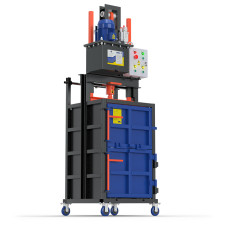
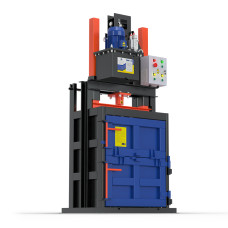
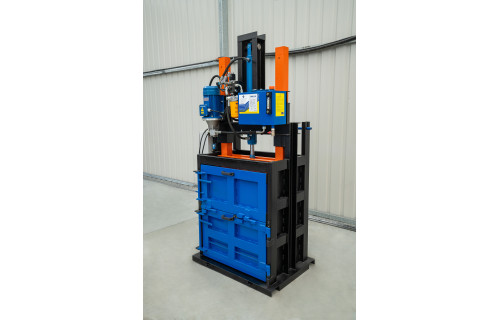
Waste balers
In store backrooms and distribution centers, balers for waste paper and plastic are ideal.
- Volume reduction of up to 90%: The devices crush empty PET bottles and cans with a force of many tons, forming the collected waste into compact rectangular bales.
- Easy transport and storage: The resulting bales can be easily stacked on pallets and stored without the risk of scattering.
- Time savings: The backroom remains clean, and store staff do not have to waste time constantly emptying small bins. Thanks to this, employees have more time for tasks that translate into product sales and running the business.
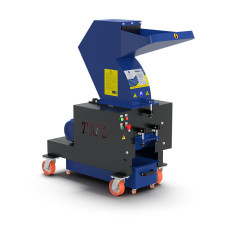
Impact shredders for plastic
For locations with very high throughput, we recommend plastic shredders. These devices continuously crush and tear apart the structure of plastic and metal packaging, which makes it impossible for them to re-enter the deposit circulation and reduces the dimensions of the raw material to the maximum. It is also an opportunity to improve the subsequent recycling process, because ultimately the packaging is turned into granulate, which will be used to produce new bottles and cans.
4. What about glass? Crushers and transport of empty glass packaging
When asking which bottles are covered by the deposit return system, let us remember reusable and single-use glass bottles. Glass is a heavy, fragile, and dangerous material in the event of damage.
At recycling points and large sorting centers where recycling of glass cullet is profitable, TechnoMaszBud jaw crushers are used. They allow safe, controlled crushing of sorted glass, drastically reducing the space needed for its storage and making it easier to pour into collection containers or onto trailers. Additionally, this reduces the risk of injury in the event of a bottle breaking - when the entire line for shredding and transporting packaging is configured, they can go directly into the crushing module, from where the ready, packed raw material is collected.
Impact shredders for waste
Also in the case of glass bottles, it is worth considering the use of shredders. For this task, the Grindex-7 model for glass waste will work best, as it also processes other materials, including plastic and wood.
5. Automation and recycling production lines – from the store backroom to the processing plant
For larger entities, secondary raw material collection points, and municipal facilities, a single crusher is only the beginning. Real efficiency is achieved by connecting machines into automated recycling and sorting lines for deposit packaging.
What does an example of an unattended TechnoMaszBud waste processing line look like?
- Raw material reception and feeding: Empty packaging (PET/cans) goes onto a belt conveyor (PT series), which is equipped with speed control (inverter) and constantly supplies material to the next sections. Example: PT-500 belt conveyor.
- Shredding and crushing: The conveyor directs the raw material directly to a shredder or to the feed hopper of a highly efficient baler/crusher. Example: Grindex-11 impact shredder for plastic.
- Capacious buffer and dedusting: The use of screw feeders with buffer tanks allows accumulation of raw material without the risk of line downtime. Example: ZP-400 hopper-feeder.
- Bale forming / loading: The crushed and sorted raw material goes directly to weighing packers or to baling stations. Example: WP-1000 weighing packer/bagging weigher.
The use of continuous belt transport eliminates manual physical work, speeds up the handling process, and reduces labor costs to a minimum.
6. The costs of implementing the deposit return system and automation – why is TechnoMaszBud worth it?
Many people analyze the costs of implementing the deposit return system for small and medium-sized stores and processing plants only through the prism of purchasing equipment. This is a mistake. The real costs are generated by the lack of appropriate infrastructure:
- Loss of warehouse space that could be used for storing commercial goods.
- High bills for removal of unremoved, uncompressed waste mass.
- Employees' work hours wasted on manually stacking and moving bags.
Investment in professional crushers for small and large stores as well as bottle return devices and sorting lines pays back extremely quickly.
By choosing machines from TechnoMaszBud, you gain:
- Solid, industrial construction: We design our equipment with harsh conditions and continuous operation in mind.
- Low energy consumption: Optimized drive systems guarantee high pressing force while limiting power consumption.
- 12 months warranty and full service: We have constant access to spare parts and provide professional technical advice.
- Support in selecting machines: We will help you complete equipment perfectly suited to the area of your warehouse and the planned throughput.
The burden of the deposit return system - easy business
Implementation of the deposit return system does not have to be a burden for your business. Properly selected shredders for PET bottles and cans, balers, and automated conveyor lines from TechnoMaszBud will transform a difficult obligation into an efficient, hygienic, and optimized process.
Do you want to find out which waste line configurations will work best in your facility or plant? Contact our technology advisors at TechnoMaszBud – we will help you choose a solution tailored to your needs and budget.