Investments supporting the environment are currently attracting increasing interest – both due to growing environmental awareness and the financial benefits flowing from a „green” business. An example is the cultivation of oxygen trees, that is, paulownia. Due to its extremely rapid growth, a paulownia plantation makes it possible to generate income already a few years after establishment. However, this is not a business for everyone: in order to fully use the potential of this species and maximize future profits, both agrotechnical issues and the possibilities of utilizing the raw material must be carefully considered.
What is an oxygen tree? The most important information about paulownia
Under the name „oxygen trees” there are selected varieties and hybrids of species from the paulownia genus (Paulownia), such as P. tomentosa , P. elongata , P. fortunei. These are the fastest-growing trees that can be cultivated in the Polish climate, and also among the fastest-growing trees in the world. They rapidly outpace native species cultivated for timber, including such „sprinters” as Scots pine or silver birch. If they are provided with optimal conditions, in terms of biomass growth rate paulownias surpass even energy willows, that is the classic source of raw material for wood chips and for pellet production.
How fast do oxygen trees grow? If the trees have access to the right amount of light, water and nutrients, the growth rate of paulownia is simply unbelievable! Already in the first years of cultivation, their growth exceeds 2 m per year. The growth of exceptionally vigorous specimens may increase by as much as 4 m in just one season! After 6 years, oxygen trees usually already reach 10-15 m in height.
A paulownia plantation does not require liquidation after harvest. Oxygen trees are characterized by the ability to regrow from the roots. New shoots emerge from the cut trunk in spring, and after a few years another harvest can be carried out. On a properly established and maintained oxygen tree plantation, several such cycles can be performed.
Due to their extremely rapid biomass growth and the huge surface area of their leaves, paulownias are exceptionally efficient „oxygen factories”: during a year, a several-year-old tree of this species produces approx. 6 kg of oxygen, while at the same time absorbing more than 8 kg of carbon dioxide. Depending on growth conditions and planting density, a hectare of „oxygen forest” produces from 10 to as much as 30 tons of oxygen annually!
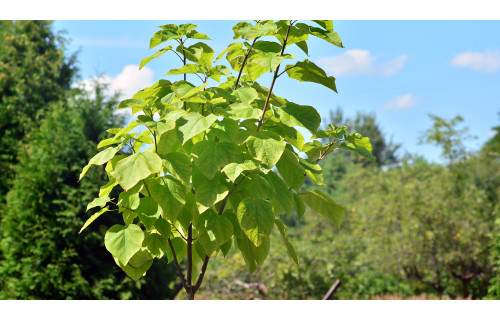
What does an oxygen tree look like? Beautiful! An additional advantage of paulownia is its ornamental value. Oxygen trees form enormous leaves over 30 cm in diameter and heart-shaped, giving them an exotic appearance. In May, they develop impressive clusters of pale violet, bell-shaped flowers – they look extremely striking, and their sweet scent and abundantly produced nectar attract bees.
Oxygen tree plantation for biomass or sawn timber
From the investor's point of view, the environmental benefits resulting from oxygen tree cultivation are added value. Real profits are of greater importance! How much can you earn from a paulownia plantation? What should be done to make the investment more profitable?
Before establishing a paulownia plantation, you should consider the intended use of the future crop. There are two main business models: cultivation for biomass or for obtaining high-quality sawn timber. A hybrid solution is also practiced.
Paulownia wood is a raw material valued, among others, in furniture making, boatbuilding, and also used for the production of musical instruments. It is relatively light (approx. 270-300 kg/m3), while at the same time durable, strong and easy to process. It is characterized by a high calorific value, which for dry wood amounts to approx. 18.5–19 MJ/kg. However, the possibilities of using this raw material depend on its quality, related to the agrotechnics used.
Cultivation of oxygen trees for biomass makes it possible to harvest the crop faster, and thus obtain a return on investment. In cultivation for energy purposes, plants are planted at a density of 900 to more than 2000 root cuttings per hectare of plantation. They can be managed for several shoots, which will quickly fill the inter-rows. Harvest is carried out 3-4 years after planting, obtaining a yield of 15-30 t/ha. Because oxygen trees regrow from the roots, after a few years the plantation will provide another batch of biomass. Importantly, paulownia wood treated as biomass does not have to meet stringent quality standards: forked boughs, crooked branches, knotty logs are also suitable for this purpose. Such raw material can be processed into firewood, wood chips, pellets or briquettes.
It is definitely profitable to have your own device for producing solid biofuels, that is, a pellet mill or a briquetting machine. Lower-quality paulownia wood intended for biomass is purchased at 250- 400 PLN/m³, that is 150-300 PLN per ton. Meanwhile, the price of a ton of pellets ranges from 1300-2500 PLN/t.
An oxygen tree plantation established for obtaining high-quality sawn timber theoretically makes it possible to achieve greater profit, however it involves considerable risk, and its maintenance is much more complicated. Planting density is lower, approx. 500-750 seedlings per hectare. You need to arm yourself with patience: to obtain class A wood, harvesting is carried out only 10-12 years after planting, when the oxygen trees reach the appropriate height and their trunks have a diameter of at least 30-40 cm. The raw material must meet strict quality requirements: the trunks should be straight, cylindrical and thick, without forks, with as few knots as possible. There is something to fight for: class A paulownia wood, characterized by the highest quality, can be sold for more than 1500-2000 PLN/m3 – of course provided that a buyer can be found for it! An alternative is harvesting already after 6-8 years – thin paulownia logs can be sold as class B or C wood, valued much lower, from approx. 900 PLN per 1 m3.
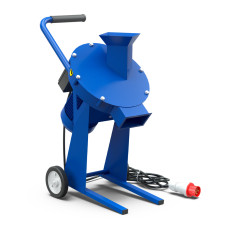
In order for paulownia trees to produce straight trunks, they require regular pruning of side shoots and removal of root suckers. Unfortunately, even systematic plantation maintenance does not guarantee obtaining premium-class raw material. About 60 tons of sawn timber are obtained from a hectare. Calculated per year, this gives an average mass increment of approx. 5 tons/ha, which is much less compared to cultivation for biomass. To increase the profitability of the investment, it is definitely worth also planning the use of „waste”, that is, branches, boughs, forked trunks. They are suitable as biomass raw material just as well as paulownias grown typically for energy purposes. Using a pellet production line, high-quality solid biofuel can be produced from them. Another possibility is processing the residues left after harvesting the trunks of oxygen trees into chips for mulching the plantation using a wood chipper.
How to establish an oxygen tree plantation in Poland?
Attention: cultivating paulownia is not a business for everyone! It can be extremely profitable, but it requires appropriate agrotechnics and a considerable investment at the start. The choice of paulownia clones adapted to Polish climatic conditions is of key importance. These include, among others, ‘Shan Tong’, ‘Oxytree’, ‘Pao Tong Z07’, ‘Nordmax21’, ‘Kirihiro’ and ‘H2F4’.
Oxygen trees are able to adapt to various environmental conditions and soil types, however their growth rate depends on habitat conditions and planting density. The basic limitation is frost resistance: oxygen tree cultivation is profitable in warm regions of Poland, where the winter temperature does not fall below -25°C. The planting date should fall in the second half of May, so as not to expose young seedlings to early spring frosts. Preparation of the site is important, that is, weed control, loosening and enrichment with fertilizers. Paulownias are tolerant in terms of reaction, they can grow in soils with a pH range of 5-8. Waterlogged land, strongly acidic soils, as well as very heavy, clayey soils are not suitable for their cultivation.
Cultivation of the oxygen tree (paulownia) - practical advice
It is worth deciding on irrigation and nitrogen fertilization of the plantation. Young oxygen trees that have constant access to moisture in the first months of growth produce enormous leaves, enabling them to carry out intensive photosynthesis.This translates into accelerated growth of shoots and roots. It is important to limit plantation irrigation in autumn, and ultimately stop it before the end of the season. Thanks to this, the seedlings will enter dormancy faster and, as a result, will withstand winter better. Older, several-year-old paulownia trees produce a deep root system, which provides them with greater drought resistance and allows them to draw nutrients from deeper soil layers.
In the first year after planting, an important treatment is cutting the oxygen trees approx. 3–5 cm above the ground. This radical cut is carried out during the dormant period, in autumn or early spring of the following year. Thanks to this, the plants will start the second season from zero, with a stronger root system. This will allow them to grow much faster and produce stronger shoots, and it also makes it possible to achieve plantation uniformity. The one-year-old paulownia shoots left after cutting do not have to go to waste. It is best to shred them directly in the field, using a PTO-driven chipper, and then use them for mulching the plantation. Chips spread around young oxygen trees (or other cultivated plants) retain moisture in the soil, limit weed growth, and as they decompose they enrich the soil with organic matter.
Is it worth investing in oxygen trees?
An oxygen tree plantation combines ecological goals with business potential, however it requires a professional approach. The purchase of certified, frost-resistant paulownia seedlings, the selection and careful preparation of the site, as well as a conscious decision regarding the purpose of establishing the plantation are of key importance. Cultivation for biomass offers a faster return on investment and is less demanding in terms of maintenance. The production of sawn timber potentially makes it possible to obtain greater profit, at the cost of many years of waiting and high labor input. It is always worth trying to make use of waste raw materials – for the benefit of the plantation and your own wallet.