Energy crops – how to utilize low-grade land and wastelands?
Poor soil does not have to lie fallow! Cultivating energy crops is not only a way to utilize wastelands and class V and VI land, but also an idea for a profitable business! Its profitability will increase significantly if you go one step further and start producing solid biomass fuel: heating pellets, briquettes, or wood chips.
Demand for biomass is constantly growing! Ecological forms of heating have gained popularity, which continues to grow. Biofuel boilers are increasingly being installed both in residential buildings and industrial facilities. Demand is also generated by the energy sector: despite the introduction of restrictions on burning full-value wood, in 2025 in Poland the share of electricity from biomass combustion increased by over 36% compared to 2024, reaching over 6.7 TWh. Meanwhile, due to the drastic decline in the supply of wood from the State Forests, the amount of sawdust from the timber industry is decreasing. Even taking into account alternative raw materials for pellet production, i.e. agricultural waste such as straw or sunflower husks, there is still a significant market gap. Energy crops have a chance to fill it!
Energy crops cultivated in Poland
Energy crops are species cultivated to obtain biomass needed for the production of renewable energy, including solid biofuels such as pellets and briquettes. They should be characterized by high annual growth, high calorific value (within the range of 15-19 MJ/kg), low soil requirements, minimal fertilizer demand, as well as high resistance to diseases, pests, and unfavorable weather conditions. In the case of biogas, biodiesel, and bioethanol production, annual agricultural crops are primarily used. Typical plantations of perennial energy crops are established to obtain raw material for the production of high-quality solid biofuels intended for combustion and co-combustion.
The physicochemical properties of fuel directly affect boiler lifespan and pollutant emissions, therefore biomass obtained from energy crops used for the production of solid biofuels is subject to restrictive quality standards. It should contain no more than 1.5% ash and 1% sulfur, and also be characterized by moisture content below 10%.
Perennial energy crops can be established on the poorest lands withdrawn from agricultural use, as well as on contaminated and industrially degraded areas. In Poland, energy willow and miscanthus are by far the most important, although interest in a number of other energy crops is gradually increasing.
- Energy willow is a common name used for various species and varieties characterized by very rapid biomass growth. The most important are basket willow (Salix viminalis) and American willow (Salix americana). It constitutes about 50% of the current area of perennial energy crops in Poland. It can be planted on any type of soil, except dry, sandy soils (class VI). It tolerates waterlogged sites and soils contaminated with heavy metals. The calorific value of willow is 17-20 GJ/t of dry mass.
- Giant miscanthus (Miscanthus x giganteus) and vigorously growing varieties of Chinese silver grass (Miscanthus sinensis) are perennial grasses reaching up to 3-4 m in height in one season. These are excellent energy crops for poor and dry soils, while also being popular ornamental plants grown in gardens. Its share in the area of energy crops in Poland is estimated at 20% and continues to grow. The calorific value of miscanthus is 17-19 GJ/t of dry mass, making it comparable to willow.
- Other perennial energy crops cultivated in Poland include hybrid poplar (Populus), Virginia fanpetals (Sida hermaphrodita), cup plant (Silphium perfoliatum), prairie cordgrass (Spartina pectinata), black locust (Robinia pseudoacacia), and Jerusalem artichoke (Helianthus tuberosus).
Is energy willow profitable?
Of course! Energy willow can grow on poor, waterlogged, and contaminated soils; it is often used for protective plantings around industrial plants, waste landfills, and along highways. As a way to utilize wastelands, it is an excellent complement to more demanding crops.
The cost of establishing a 1-hectare energy willow plantation ranges from PLN 4,000-7,500, depending on the adopted agricultural technology. In the case of establishing a plantation from your own cuttings, the cost drops to PLN 3,500-4,000. It is an investment for years: the plantation can be efficiently exploited for 25-30 years in the same location. Willow is usually cultivated in a 3-year cycle: harvesting takes place once every three years. In this way, higher wood calorific value and a greater total amount of biomass are obtained compared to annual harvesting, while also reducing harvest frequency, which translates into lower costs.
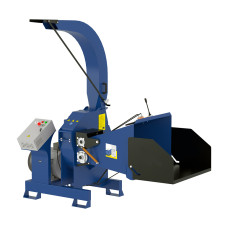
Harvesting energy willow can be carried out in a single stage using a self-propelled forage harvester. The wood chips obtained this way then require drying. In the case of smaller plantations, a two-stage harvest is often used: the shoots are cut and then left to dry on the plantation area. After a few weeks, the wood is shredded using a mobile wood chipper into high-quality dry chips.
How fast does energy willow grow? Extremely fast! Growth in the first year of cultivation can reach 3 m, and after three years the shoots are up to approx. 6 m long and several centimeters in diameter. The average dry mass yield at harvest in the 3rd year of cultivation is approximately 45 t/ha. On moist class III and IV soils, willow grows more intensively; after 3 years from establishing the plantation, over 60 tons of dry mass can be harvested from 1 hectare!
How much can you earn from energy willow? Quite a lot. Purchase prices for energy willow chips range from PLN 150-300 per ton, which in a 3-year cultivation cycle with an average harvest of 45 tons of dry mass per hectare gives PLN 2,250-4,500 annually.
The profitability of energy crops can be increased if, instead of selling the harvest to a purchasing center or local heating plant, we decide to produce biofuel on the farm. Pellets made from energy willow are more expensive than wood chips; their price averages PLN 800-900 per ton. The willow biomass pelletizing process allows the fuel density to be increased more than threefold and the energy concentration per unit volume to be increased 4.5 times compared to wood chips.
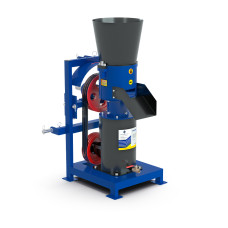
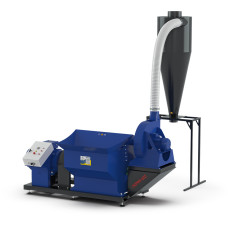
Energy willow wood can be shredded using a wood chipper directly in the field or on the farm. The next stage is grinding using a hammer mill. Finally, the raw material is granulated using a pellet machine. Alternatively, at this stage one can decide on the production of fuel briquettes using a briquetting machine.
Importantly, all of the above devices are also useful for many other applications on the farm. For example, a universal pellet production machine can also produce this type of fuel from straw – both from the field and from miscanthus straw, the second most popular energy crop.
Miscanthus pellets – energy grass as an alternative to willow
Where it is too dry for willow, miscanthus will perform excellently! Energy grasses are suitable for cultivation on soils poor in nutrients. They do not require protection against diseases or pests, nor other agricultural treatments.
A miscanthus plantation can be efficiently exploited for 15-25 years, and its liquidation is much simpler than in the case of willow. Moreover, harvesting can be carried out every year without a decline in productivity. Miscanthus is a perennial grass with a vegetation cycle typical of perennials. The above-ground part dies back every year to regrow in spring from overwintering roots. Within a few months, the clump reaches up to 3-4 m in height! Harvesting can be carried out already from the first year of cultivation, although during the first 2 years the plantation has not yet reached its full production potential. In autumn, in the planting year, an average of 5-7 t of dry mass per hectare is harvested; in the following season the yield increases to approx. 8-12 t/ha. From the 3rd year of cultivation, the annual dry mass yield ranges between 17-25 t/ha. Miscanthus is a thermophilic plant: in the warm climate of southern Europe, yields exceed 30 t/ha. In the face of global warming, similar results may soon also be possible in Poland!
In the case of miscanthus, the main obstacle is the high cost of establishing a plantation, reaching PLN 12,000-25,000/ha, resulting mainly from the high prices of seedlings. Due to the impressive biomass yield and the perennial nature of the crop, the investment quickly pays for itself. Especially if, instead of limiting oneself to selling miscanthus straw, pellet production is started. The price of dry, compressed miscanthus straw ranges from PLN 200-400/t. Meanwhile, miscanthus pellets can be sold for several times more! Prices start from PLN 1,000-1,300 for wholesale quantities and increase to PLN 1,600-1,800 in the case of individual customers buying bagged pellets.
Production of pellets from miscanthus is simpler and cheaper than in the case of wood pellets. It can be produced using the same machines as pellets from straw and other farm waste. The process consists of shredding the raw material using a shredder, and then pelletizing it in a straw and hay pelletizer or a universal pellet machine. To obtain the highest quality pellets, for which a better price can be obtained, it is worth investing in a professional pellet production line.
Funding for energy crops
Currently, there are several opportunities in Poland to obtain subsidies for energy crop cultivation. The Strategic Plan for the Common Agricultural Policy for 2023–2027 (CAP SP 2023–2027) provides subsidies tailored to this eco-business! Support for “Investments contributing to environmental and climate protection” allows individual farmers to receive up to 65% reimbursement of costs (or 80% in the case of farmer groups), including for the purchase of specialized biomass harvesting machines, branch shredders, forage harvesters and planters, as well as the construction of biomass storage facilities. The funding limit is as much as PLN 200,000 per farm.
Cultivation of energy crops also makes it possible to obtain Basic Income Support, which according to forecast rates for 2026 is expected to amount to approx. PLN 500–600/ha.
Summary
Energy crops allow diversification of crop structure and farm income, as well as profitable utilization of poor land. The key to success is matching the type of energy crop to soil conditions (dry soil – miscanthus, wet soil – willow). Maximizing profits will be ensured by processing the biomass before sale into pellets or briquettes, for which several times higher prices per ton are obtained compared to raw wood chips or straw. This investment is supported by EU and national funding programs offering reimbursement for the purchase of specialized machinery and annual direct payments per hectare of cultivation.