Seed calibration before sowing – a way to achieve higher yields
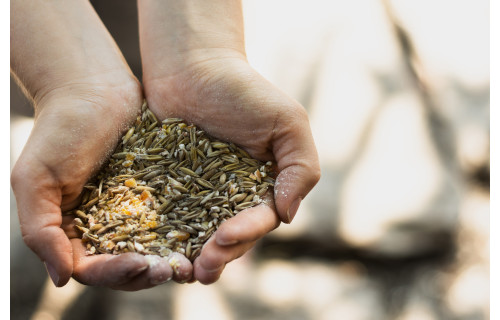
The quality of seed material is one of the key factors influencing crop success. This principle has been confirmed by numerous scientific studies concerning hundreds of different species and varieties of cultivated plants. More importantly, it has been proven in practice by countless farmers and gardeners.
The most important physical parameters used to assess the standard of seed material include seed size, weight, and purity. Large seeds are characterized by higher germination capacity and vigor, grow faster after emergence, develop a stronger root system, and ultimately make it possible to achieve higher yields.
For this reason, one of the key treatments aimed at improving seed material is seed calibration.
What is seed calibration?
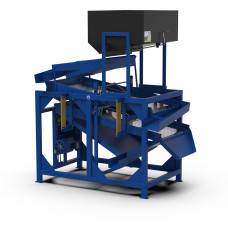
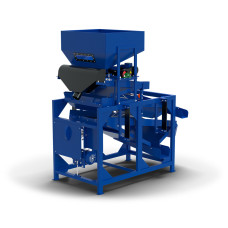
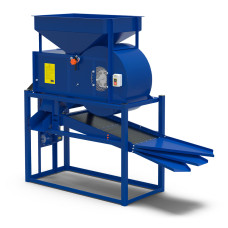
Seed calibration consists of sorting seeds according to their size, weight, and shape. The device used for this purpose is a grain calibrator, which quickly and precisely divides seed material into fractions while simultaneously removing contaminants such as stones, sand, chaff, husks, sticks, etc. It enables precise selection of high-quality seeds characterized by the appropriate size and weight. At the same time, seeds that are too small and deformed are removed, as they are incapable of germination, emerge with delays, or develop into weak seedlings.
In addition, seed material calibration makes it possible to remove weed seeds, which are lighter than cereal grains and most other agricultural crops. This minimizes the need for herbicides and prevents weeds from competing with cultivated plants for water, nutrients, light, and living space.
The impact of seed calibration before sowing on germination and plant development
Within the same species and variety, seed size directly affects sowing value, i.e. the ability to achieve uniform emergence and, in the long term, produce high yields. This includes both weight, defined as the weight of 1000 seeds (TSW), and uniformity in size and shape. Large, well-developed seeds selected during the calibration process contain properly developed embryos and are rich in reserve substances. For this reason, they germinate faster, and the seedlings produced from them grow more vigorously and root better. As a result, they are more resistant to unfavorable soil conditions (such as drought or nutrient deficiency) and other environmental stresses, cope better with weed competition, and show lower susceptibility to pathogens. These benefits also persist in later stages of plant development, ultimately resulting in more abundant yields compared to plants grown from seeds with smaller size and weight. Numerous studies also confirm the greater resistance of large seeds to excessively deep sowing due to their higher ability to penetrate the soil cover.
Sowing only large seeds selected with the use of a calibrator ensures uniform plant density and thus better field utilization. Eliminating small seeds that are incapable of germination or produce weak seedlings helps avoid empty spaces in the crop stand.
Another benefit of seed calibration before sowing is obtaining seed material that is uniform in size and shape. The result is uniform emergence, which directly affects yield potential, harvest quality, and the efficiency of agricultural treatments.
The phenomenon of delayed seedlings being suppressed by larger and stronger plants that germinated earlier is eliminated. Plants that emerge simultaneously continue their development at a similar pace throughout the entire growing season. As a result, a uniform crop stand is obtained, enabling precise application of fertilizers and plant protection products at the recommended development stages for a given species and variety. Plants mature at the same time, making it easier to determine the optimal harvest date and thus obtain higher yields of better quality.
Seed calibration means higher yields of better quality!
Seed size affects not only germination, rooting, and seedling growth, but also the yield of the resulting plants. Therefore, calibration enabling the selection of seeds with the desired size translates into direct financial benefits!
The direct benefits resulting from seed material calibration are proven by a synthesis of the results of hundreds of experimental studies on various cultivated plant species, published in 2024. It was shown that larger seeds are characterized by 12–18% higher germination capacity and 50% greater resistance to excessively deep sowing. The increase in yield resulting from mechanical seed sorting and sowing only fractions of optimal size varied depending on the species. In cereals, yields were 10–15% higher under standard conditions and 22% higher under drought conditions. Different maize varieties yielded 8–18% more abundantly, while legumes produced yields on average 20% higher.
A particularly clear effect of grain calibration was observed in cowpea (also known as yardlong bean). Seeds calibrated using sieves with mesh diameters of 5.5 mm and 4.8 mm were compared. It was shown that larger seeds exhibit 10–15% higher germination capacity under field conditions. They develop a root system and first true leaves faster. Ultimately, they grow taller and branch better, producing 25% more pods containing seeds with 18% greater weight. As a result, yields increased by as much as 35% compared to plants grown from smaller seeds.
Other studies have demonstrated similar benefits resulting from the use of larger seeds for wheat, triticale, oats, barley, rice, maize, amaranth, sunflower, soybean, green bean, sugar beet, chickpea, rapeseed, pumpkin, safflower, and many other agricultural and horticultural plant species grown in various climate zones.
Seed material calibration positively affects not only the size of future yields but also their quality characteristics. It has repeatedly been proven that plants grown from large seeds produce larger and heavier seeds compared to individuals of the same species and variety grown from smaller seeds. For example, in peas, plants grown from seeds weighing 0.25 g produced grains 12% larger than those grown from seeds weighing 0.18 g. A comparison of wheat grown from grains with a TSW = 42 g and wheat obtained from grains with a TSW = 32 g showed that the former produced ears approximately 1.5 cm longer, containing on average 5 more grains with an average weight 8% higher. As a result, sowing heavier seeds increased yield by 18%.
In the case of sunflower, larger seeds produced plants with larger flower head diameters, a greater number of seeds per head, a higher percentage of filled seeds, and ultimately higher yields both per hectare and per plant.
The effect of grain calibration on sowing precision
Seed calibration directly affects the precision of sowing with pneumatic seed drills. Uniform seed material makes it possible to precisely adjust optimal vacuum parameters, disc rotation speed, and spacing. This minimizes double sowing and empty spots (misses), resulting in better point precision and more even seed distribution along the row. The effect is better field density and higher yields. Moreover, uniform seeds sown with a seed drill are placed more precisely in the soil at the same depth, which translates into uniform emergence.
The effect of seed calibration on sowing precision using pneumatic seed drills has been confirmed by numerous studies concerning cereals, maize, cucurbits, legumes, rapeseed, cotton, peanuts, and many other cultivated species.
In summary:
Seed calibration is a simple way to obtain uniform, high-quality seed material free from contaminants and grains that do not meet standards. This results in more uniform emergence and optimal field utilization, facilitates agricultural treatments, and above all makes it possible to achieve higher yields of better quality.
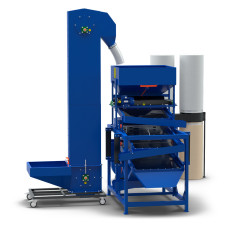
Grain calibrator is a useful device on every farm! Precise seed sorting before sowing is indispensable, especially when using one’s own seed material (farm-saved seed). In this simple way, yields up to 15–20% higher can be achieved compared to using untreated seeds. For farms and facilities focused on producing high-quality seed material, the best solution will be a professional set for lifting, calibrating, and cleaning seeds.
Bibliography / sources
- Ambika, S., V. Manonmani, and G. Somasundaram. "Review on effect of seed size on seedling vigour and seed yield." Research Journal of Seed Science 7.2 (2014): 31-38.
- Bustos-Gaytán, A., et al. (2025). Advancements in pneumatic seed-metering devices: A review of numerical and experimental approaches. Results in Engineering, 26, 105626.
- Ghassemi-Golezani, K. et al. (2011). Germination of different seed size of pinto bean cultivars as affected by salinity and drought stress. Journal of Food, Agriculture & Environment, 9(2), 550-554.
- Gierz, Ł., & Koszela, K. (2016). Analysis of seed distribution during sowing with a precision seeder. Agricultural Engineering, 20(2), 45-53.
- Kalita, P. and A.K. Choudhury, 1984. Effect of varieties, seed sizes and seed rates on the yield of wheat. Ind. J. Agron., 29: 287-290.
- Kumar, D. and R. Seth, 2004. Seed yield response of fodder cowpea (Vigna unguiculata (L.) Walp) varieties to varying seed rate and seed size. Seed Res., 32: 149-153.
- Masiura, M., et al. (2018). The impact of cereal seed fractioning on sowing precision with pneumatic seed drills. Problems of Agricultural Engineering. 2018, vol. 26, no. 2, pp. 27–36.
- Szot, B., & Stępniewski, A. (2006). Physical properties of seeds and their sowing value. Acta Agrophysica, 7(4), 1055–1065.
- Weissmann, K., Raja, R., Gupta, S., Patel, M., & Buehler, A. (2024). Seed Quality Enhancement: A Review of Techniques and Their Impacts on Crop Yield. Plants, 13(4), 582-601.
- Zaremba, R., et al. (2018). The impact of geometric features of maize seeds on sowing quality indicators in pneumatic seed drills. Agricultural, Horticultural and Forestry Technology. 2018, no. 1, pp. 11-13.
- Zembold-Guła, K., & Grzesik, M. (2013). The effect of seed size and weight on seed quality and vigor. Journal of Research and Applications in Agricultural Engineering, 58(4), 213–217.