Secrets of Pellet Production. How to Produce Pellets?
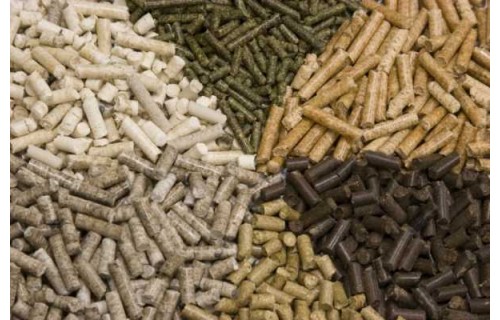
Among many methods of wood biomass utilization, pellet production deserves special attention. It is one of the best ways of processing wood waste (such as sawdust, shavings, chips or bark) or other biomass (e.g. straw or seed husks) into an ecological product with a wide range of applications.
Here are the main advantages of pellet production:
- The technology is quite simple.
- A minimal number of personnel is required to operate the equipment.
- The production cost is quite low, while the return on investment is high.
- It enables the processing of waste of various sizes.
Raw Materials for Wood Pellet Production and Their Properties
Wood pellets can be produced from various species of wood. The properties of the raw material affect the characteristics of the finished granulate and the production process itself. This seems to be particularly important in small-scale pellet production, because industrial equipment is not as sensitive as a smaller, lower-power machine.
The raw material for wood pellet production is shredded wood with a thickness of about 1 mm and a length of up to 3-4 mm. A great advantage is that specially prepared shavings, as required for example for particle board, are not needed in pellet production. The presence of mineral impurities and metals in the raw material is not allowed.
Color of Wood Pellets
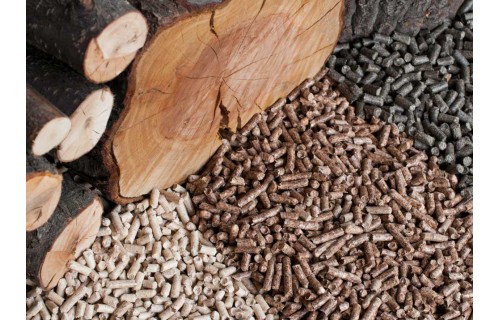
The color of pellets depends primarily on the type of wood from which they were produced.
Pellets obtained from softwood such as pine, spruce or fir will usually have a light color, from straw-yellow to light brown. In turn, pellets made from hardwood such as oak, beech, ash or birch are characterized by a darker color, from brown to dark brown, and sometimes even black.
The shade of pellets may also be influenced by other factors, mainly moisture content, drying methods used in the production process or the presence of dyes.
Adhesion of Wood Pellets
Apart from color, the quality of pellet bonding also depends on the raw materials. The binder in the pellet pressing process is natural lignin present in wood. The lignin content varies in each species, therefore the more lignin in the wood, the higher the quality of the pellets.
To assess which wood is optimally suited for pellet production, let us look at the percentage lignin content in wood:
- Pine – 27.05%
- Spruce – 27.00%
- Fir – 29.89%
- Beech – 27.72%
- Birch – 19.10%
- Aspen – 21.67%
On average, in softwood trees the lignin content ranges between 26-30%, in hardwood trees: 19-28% of the total mass of absolutely dry wood. Of course, the lower the lignin content, the greater the amount of screenings obtained, which means higher electricity costs and a slight reduction in efficiency.
Influence of Wood Hardness on the Obtained Wood Pellets
Another important factor in pellet production is wood hardness. The harder the wood, the more difficult it will be to process it into shavings and compress it. Therefore, in pellet production from harder wood, electricity consumption increases and pellet mill parts: knives, dies or rollers wear out faster.
Let us compare the hardness of some wood species:
- Pine – 260 kG/cm2
- Spruce – 235 kG/cm2
- Fir – 255 kG/cm2
- Beech – 555 kG/cm2
- Birch – 425 kG/cm2
- Aspen – 240 kG/cm2
One cubic meter of pellets made from denser wood species will have higher bulk density and greater calorific value. For example, one cubic meter of birch pellets will emit more heat than one cubic meter of pellets made from pine sawdust.
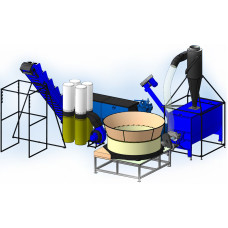
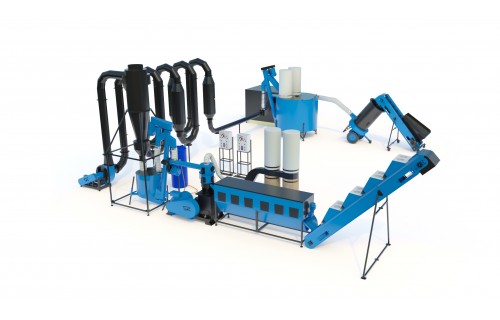
Operation of the Wood Pellet Production Line
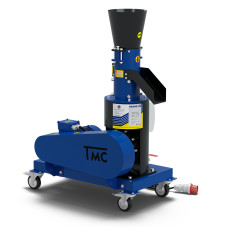
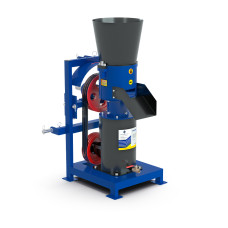
In the pellet production process, the pressing stage plays a key role. Sawdust is fed onto the die of the pellet mill, and the rotating rollers moving over the die press the sawdust into the holes, giving them the characteristic granule form. Proper operation of the machine will help minimize wear of the rollers and the die and ensure that pressing runs smoothly and without failures.
Contrary to appearances, pellet production has many nuances, and the technology is very sensitive to changes in pellet mill settings. Very often, situations occur where pellets do not come out or the die becomes blocked immediately after switching on the pellet machine.
Let us take a look at what the process of starting the pellet mill looks like (under conditions where the die has already been run-in).
Starting the Pellet Production Machine Step by Step:
- Sprinkle the die with a mixture of oil and sawdust.
- Switch on the main motor rotating the rollers, but do not feed shavings yet.
- Wait until pellets with oil come out. Then set them aside or discard them (depending on whether you want to reuse them).
- After pushing pellets with oil through the die, switch on minimal feeding of shavings to the press. Remove shavings until pellets without oil appear.
- When clean pellets without oil appear, increase the sawdust feeding speed to the optimal level.
Additional tips:
- For smoother start-up and shutdown of the pellet mill and to increase die efficiency, first feed a mixture of pellets with oil or sawdust with oil. This basic mixture allows smoother start and stop of the press and increases die efficiency. If we stop the pellet press with ordinary shavings of standard moisture and without oil, the compacted shavings stick to the die walls, and then at start-up very high force is needed to push them through. In many cases this force is insufficient and the press becomes clogged, resulting in increased load. This also causes faster wear of the motor and transmission mechanisms of the press.
- Manufacturers of dies and presses recommend mixing sawdust with clean automotive diesel oil to reduce the friction force between the mixture and the die walls, and then discarding the oil pellets obtained, preparing a new solution for the next shutdown and start-up.
Some specialists, instead of clean and relatively expensive oil, mix shavings with cheap used oil from cars, gearboxes or other mechanisms, and reuse the oil pellets obtained after starting the press instead of a new mixture, adding some used oil again if necessary. The advantage of such an “improvement” is significant oil savings, while the disadvantage may be faster die wear, because used oil contains a large amount of metallic impurities.
- Carefully read the operating manual of your machine to obtain detailed information on its start-up and use.
Blocked Pellet Production Machine (Pellet Mill)
What should be done when pellets do not come out of the machine and attempts to push through the die do not bring results?
- Stop the pellet mill: The first and most important step is to stop the machine immediately. Forcing it further may lead to more serious damage to mechanisms and expose you to danger.
- Check the blocked die holes: After stopping the machine, carefully inspect the die and locate the blocked holes. Depending on the degree of clogging, they can be carefully punched through or drilled. It is important to use appropriate tools and exercise caution so as not to damage the die.
- Diagnose the cause of clogging: Even if the technological parameters of the pellet mill (roller pressure, sawdust moisture at 12-15%, fractional composition) seem correct, other problems may have occurred that led to clogging. Pay special attention to:
- Condition of the rollers: Make sure all rollers are properly mounted and show no play. Even slight loosening of one roller can significantly reduce machine efficiency and lead to blockage.
- Roller pressure: A drop in roller pressure may be caused by failure of a valve or another element of the hydraulic system. Check pressure gauges and sensors to rule out such problems.
- Additional factors: It is also worth checking other potential causes of clogging, such as:
- Excessive moisture of sawdust
- Inappropriate sawdust thickness
- Presence of impurities in sawdust
- Incorrect machine configuration
- Remove the cause of clogging: After identifying the cause, it should be eliminated. This may require replacing a damaged component, adjusting machine parameters or changing the type of sawdust.
- Restart the machine: After removing the cause of clogging and thoroughly cleaning the pellet mill, it can be restarted. Carefully observe the machine’s operation and make sure it works properly.
Optimization of the Pellet Production Process
Automation and visualization of the pellet production process play a key role in its optimization. This allows continuous monitoring and identification of potential problems, which translates into better product quality and work efficiency.
Important Indicators to Monitor:
- Amount of screenings: Tracking the amount of screenings after sorting finished pellets on a sieve informs about material losses and allows improvement of the sorting process.
- Efficiency coefficient: A scale measuring the mass of shavings fed into the press makes it possible to calculate the efficiency coefficient for each shift.
- Press speed: Monitoring the press speed during production allows identification of potential performance problems.
- Downtime duration: Recording the time of stopping and starting the line and the number of downtimes during a shift facilitates identification and elimination of production bottlenecks. Starting and stopping the pellet mill generates heavy loads and wears out the die and rollers. Monitoring their condition and minimizing downtime is crucial for cost optimization.
- Granulate quality: It is important that pellets are extruded from the entire surface of the die, and not only from some of its parts. Uneven pressing may indicate, among other things, die or roller failure.
Factors Affecting Pellet Quality:
- Raw material moisture: Pellets made from wet shavings have greater volume and lower quality than those made from dry shavings.
- Fractional composition of raw material: Large shavings are more difficult to compress and may cause pellet disintegration.
- Raw material species: Pellets from softwood are generally of better quality than those from hardwood.
- Wear of die and rollers: Worn dies and rollers do not ensure proper compression of shavings.
- Gaps between rollers and die: Incorrect gap settings may lead to uneven pressing.
- Pellet diameter: A smaller pellet diameter under the same pressing conditions usually means better quality.
In summary: it is worth remembering that the selection of raw material in wood pellet production has a significant impact on the characteristics of the finished product. The quality of granulate also largely depends on proper settings and operation of the pellet production machine. Indicators that allow optimization of the production process and the most efficient production of wood pellets may be helpful.