Pellet production technology for a small or medium-sized plant
I would like to present an excellent idea for opening a home-based, small or medium-sized enterprise – a fuel pellet production plant. Such a plant brings high profits, while requiring little investment with low risk
Energy resources have always been in high demand, especially now, when times of energy crisis have arrived. Therefore, a venture in the energy sector has great chances for success and development. A pellet plant produces biofuel in the form of pellets. Fuel pellets are produced by processing waste from the wood industry, straw, hay, sunflower husks, dry sunflower and corn stalks. Fuel pellets are an excellent alternative fuel.
The demand for pellets increases every day. The price of 1 ton of pellet fuel is about 200 euros. In order to produce pellets, it is necessary to purchase raw materials for the plant. Raw materials for pellet production may include sawdust, small wood chips, straw, sunflower husks, etc.
To produce 1 ton of fuel granules, 7.4 cubic meters of sawdust are required. Sawdust costs 5 euros per cubic meter. Thus, the gross profit amounts to:
200 € — (5 € * 7.4) = 163 € (approximate value)
And this is only the profit from 1 ton of alternative fuel.
After deducting all costs (electricity, wages, packaging, transport), profitability still exceeds 100%. The profitability of a sawdust processing plant etc. into fuel pellets is one of the highest in the waste processing sector.
The pellet market covers more and more consumer groups. Hard fuel granules are actively used for heating premises, and in power plants – for generating electricity. In addition, the active use of pellets has begun through gas generators in trucks as an alternative to liquid fuel. Pellet granule production is a great business idea that can be implemented with minimal investment expenditure.
The plant should produce high-quality pellets
In order to launch factory pellet production, it is necessary to thoroughly study the technology of this production. Pellets are an invention of the mid-last century. In order to reduce the costs associated with removing waste from his own sawmill, Rudolf Gunnerman decided to press sawdust directly at the plant. In this way, he reduced the amount of waste. As it turned out, pressed sawdust and wood chips burn much more efficiently than ordinary wood – the heat output of pellets is 2.5 times higher. The calorific value of wood fuel depends on its carbon content. The more carbon it contains, the greater the heat output. Cellulose particles of ordinary raw wood, besides well-burning carbon, also contain a lot of hydrogen and oxygen, whereas during pressing the cellulose particles are destroyed, releasing hydrogen and oxygen in the form of gases.
Another significant advantage of pellets is their combustibility. When wood burns, it loses 85% of its mass in the form of volatile gases, the remaining 15% is ash. However, during pellet combustion, ash amounts to 0.75-1.5% – depending on the raw materials from which it was made. In addition, fuel pellets contain 2 times less moisture than wood. When forced through the die under pressure and due to mechanical friction, the raw materials (and therefore the pellets) heat up to 110 degrees Celsius, which reduces moisture by half.
Pellet production technology for a small plant
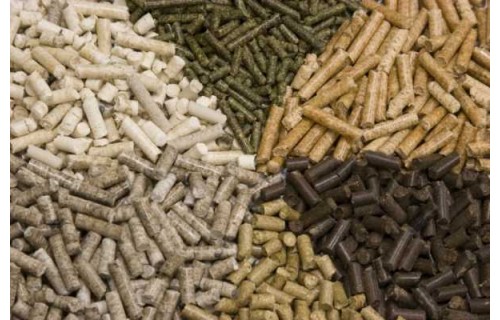
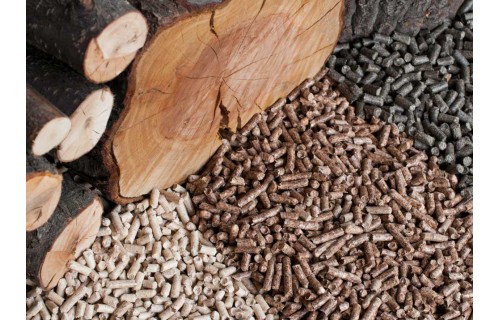
The pellet production business is a waste processing plant. Engaging in waste processing is current, humanitarian and, of course, profitable. Especially if we take into account the fact that waste is processed into ecological fuel. At such a plant, fuel pellets can be produced from various types of raw materials. These include sawdust, wood chips, bark, straw, sunflower husks, dry corn stalks, etc. The technical parameters of fuel pellets depend on the raw materials from which they were produced.
The price of pellets depends on the percentage of ash content – the higher it is, the cheaper the wood granules are.
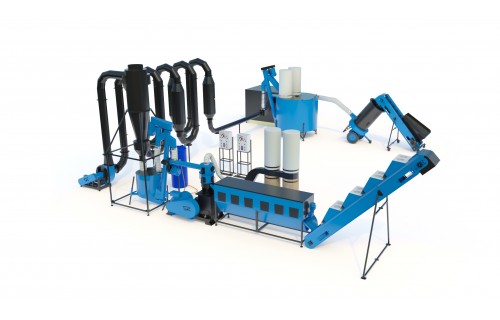
The production technology is simple. First of all, it is necessary to grind the raw materials to the size of fine sawdust, moisten them to 12% – 18% (depending on the raw materials). Then the raw material is fed into a roller, flat-die and multi-cone or other granulating press, where, like in a meat grinder, it is pressed through a special grid die. We obtain ready cylindrical pellets. The length of the pellets can be adjusted using a cutting knife that moves closer or further from the die.
The granules are pressed thanks to a special substance in wood – “lignin”, which is released during pressing and, when heated, turns into a natural glue. In addition, tree resin burns for a long time and evenly.
Pressing equipment must be installed at the plant
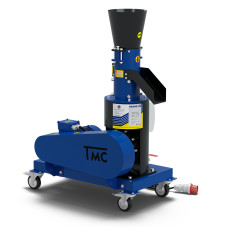
The cost of equipment for a fuel pellet production plant is relatively low. Such pellet mills are available both for small and home-based enterprises. They are of the roller or screw type. We will consider flat-die roller presses. The cost of such granulators depends on their performance. For example GMK-260 (capacity on pellets – up to 120 kg/h) can be purchased at a price of 8,272 PLN, and the power of the electric motor of such a granulator is 11 kW 380 V. There are also versions with better performance – over 300 kg/h, but the price is also slightly higher – 23,843 PLN (PRIME-300). The motor power of PRIME-300 is 22 kW 380 V. In addition, on such granulators it is possible to press not only fuel pellets, but also feed. The productivity of the granulator when pelleting feed increases at least two times compared to pellets.
For fuel pellet production, the plant needs a shredder. For shredding straw and hay we can offer RD-500 Shredder.
It is also important to understand that during continuous operation of the granulating press for 3-5 months, it will be necessary to replace high-pressure parts and components. Therefore, one should not forget to take into account fixed costs associated with the die and rollers – these are the main working parts of granulators. If pellet production is carried out only from soft raw materials (straw, hay), the service life of the die and rollers increases more than twice. Additionally, electricity can be saved by constant operation under the same loads, which also contributes to increased productivity.
ALTERNATIVE HEATING SYSTEMS INCREASINGLY CANNOT DO WITHOUT PELLETS
In any production, the main issue is always sales. The most popular application for pellet plant products is heating premises with pellets using special boilers. But there are also other sales markets – pellets are used as litter for pet trays.
In our country, pellet boilers with high efficiency up to 85% are becoming increasingly popular. They have been widely used for a long time. This type of solid fuel boiler can operate without human intervention for up to 7 days. Such operation is possible thanks to the bulk nature of fuel pellets, which allows filling the furnace with solid fuel through a programmable controller that controls the screw feeder. The filling process is automated. The level of automation is such that the next portion of granulated wood is independently fed from the hopper. In this way, the set temperature is maintained. Fuel granules are ignited by a special electric heater and fan. Such furnaces are also equipped with a special pellet burner, which allows maximum use of solid pellet fuel.
Pellet boilers are easy to maintain. They need to be cleaned from ash once a month. Such furnaces are designed for domestic use 15-500 kW and for industrial purposes up to 2 mW. The service life of furnaces exceeds 20 years. A pellet-fired furnace of the Austrian company OkoFen is shown in the photo.
Pellet furnaces are a serious alternative to gas furnaces, although granulated wood is not only efficient fuel for solid fuel furnaces, but also the best alternative to wood for ordinary stoves.
The following are examples of other uses of pellets.
Cars can be fueled with pellets
Over time, sales of factory-produced pellets from small production will expand significantly. Already in the mid-20th century, trucks operated on wood fuel. The internal combustion engine was essentially the same as today. The cars operated on gas obtained from a gas generator through wood pyrolysis.
A gas generator is a device by means of which combustible gases are obtained from solid fuels. This process is called pyrolysis – the breakdown of heavy molecules into lighter ones under the influence of high temperature and lack of oxygen.
Today we are returning to this type of fuel for cars. But, for example, a “Gazelle” car equipped with a gas generator consumes 1 kg of wood per 1 km. This means that for 100 km it would be necessary to carry 100 kg of wood. In this way, significant space in the car would be occupied by the gas generator and fuel for refueling. In addition, refueling is required every 50 km, and the car must accelerate gradually, allowing the gas generator to switch to increased power mode. All disadvantages are eliminated thanks to pellets. The bulk nature of pellets allows automatic refueling of the gas generator. The dimensions and mass of a pellet gas generator are smaller. An electronic microprocessor system monitors the acceleration of the car and, at the moment of a sudden load change, automatically connects traditional fuel. In addition, pellets have higher density and calorific value, they emit gas more intensively, therefore the number of breaks for switching the gas generator to another power decreases. Dense and calorific fuel granules require less space in the body. In addition, pellets reduce solid fuel consumption threefold to 0.3 kg per 1 km. Even if gasoline is briefly used during sharp acceleration of the car, consumption is still more than twice lower compared to traditional fuel. If we drive in economy mode, gasoline can be completely abandoned. Then the cost of 1 km is 0.04 $, 1 kg of pellets = 0.11 $/3 (consumption per 1 km = 0.3 kg) = 0.04 $/km.
Another important advantage of fuel pellets is that when gas is formed from wood pellets through pyrolysis, no toxic substances are released. This is ecological fuel.
Pellets are used as fuel for power plants
Pellet consumption is growing every day, finding more and more new applications. The European Union plans to reduce harmful emissions into the atmosphere by 20% already by 2020. For this purpose, it is planned to increase the use of biofuel in power plants. And such “green power plants” are cheaper even than solar or wind power plants.
Most large European power plants are switching to granulated wood fuel. Mobile power plants powered by granulated wood fuel are appearing. More and more wood pellet furnaces are being installed. And if we take into account the fact that oil and gas are constantly becoming more expensive, the use of gas generators for trucks and agricultural machinery will become more frequent. Today this is only the beginning of the development of the use of new fuel. Its need will grow every day.
It should be noted that small and family enterprises should already start producing new generation fuel and be ready for continuous growth in pellet demand. Such a business is particularly interesting because it does not require large investments.