Pellet production line: a new stage in agriculture and enterprise
Representatives of agriculture, farmers and households need equipment that will help them significantly reduce costs, raise their business to a completely new level, and even simply provide their home with warmth, coziness and comfort.
Nowadays, every farmer or entrepreneur tries to reduce costs and optimize the household. The purchase of ready-made feed mixtures is becoming increasingly expensive, because we observe excessive expenses for raw materials, grain spoils quickly – animals begin to get sick.
On the other hand, one must also think about another problem, which is the heating season. Purchasing wood is currently expensive, and it is better not to even mention gas heating – it is simply a real luxury! Representatives of agriculture, farmers and households need a saving alternative that will help them significantly reduce costs, raise their business to a completely new level, and even simply provide their home with warmth, coziness and comfort.
ADVANTAGES OF PELLETS AND GRANULATED FEED
We started our activity with the production of compact equipment that allows the production of fuel pellets and granulated feed in domestic conditions. Affordable price, various modifications and mobility created market demand for these devices. Subsequently, interest from entrepreneurs increased, first only in our country, but soon orders began to come from abroad. The demand for more efficient and large-sized equipment quickly increased.
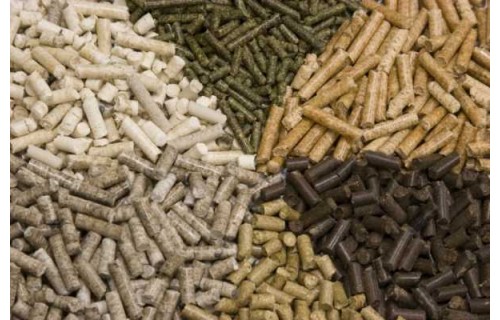
After 7 years of activity, we offer modern and highly efficient pelletizing lines that allow the production of high-quality fuel pellets, namely:
• with high combustion and heat output performance;
• with low ash content;
• with low moisture content;
• with high bulk density.
The finished feed granules also have high quality characteristics:
• high nutritional value;
• easy digestibility;
• the granules are completely purified from bacteria and fungi.
The production of fuel pellets is especially important for small and medium-sized enterprises. Currently, the number of product distribution channels is increasing more and more. Pellet boilers have become a salvation for households and business owners, because the prices of biofuel – pellets are quite affordable.
Houses and farm buildings are heated with pellets, they are used for bio fireplaces. This type of fuel is also used in manufacturing plants.
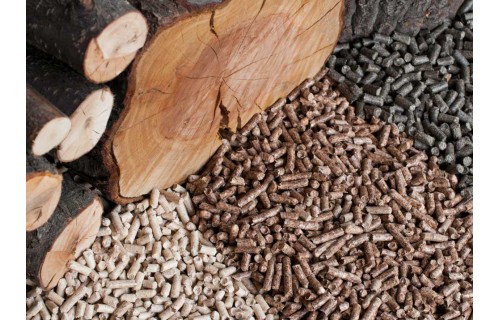
An undeniable advantage is also environmentally friendly fuel. When pellets are burned, harmful chemical substances are not emitted into the atmosphere, which means that we have finally begun the fight against the global problem of harmful emissions. In Europe, fuel pellets are produced from waste of the wood industry: bark, sawdust, shavings, but production of pellets from sunflower husks, straw, rapeseed, sugar cane is also popular. Currently, agricultural enterprises do not need to dispose of waste after harvesting crops from fields and eagerly use them for the production of fuel pellets on their own.
PELLET PRODUCTION LINE FROM THE COMPANY „TECHNOMASZBUD”
Thus, for the production of high-quality pellets, comprehensive equipment is required, which will allow:
1. weighing the amount of raw materials for the production of feed mixture;
2. grinding raw materials for further pelletizing;
3. drying sawdust to improve combustion efficiency;
4. pelletizing raw materials;
5. cooling the pellets;
6. transporting pellets into big-bag sacks.
An extraction system is also required for the entire process, which will collect dust. This dust can be used in subsequent production.
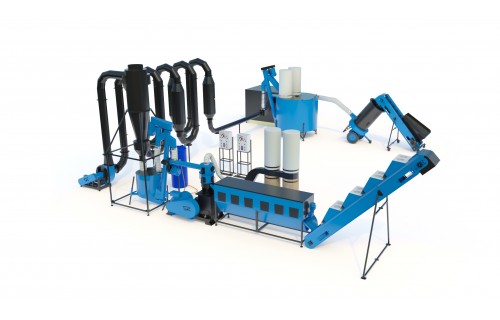
One of the more important features that a pelletizing line should have is energy saving. Among all the advantages, the pelletizing line should be economical in its energy costs, otherwise the production cost of pellets will be too high. Our pelletizing lines meet all the requirements necessary to run a profitable enterprise. The pellet and granule production line consists of the following components:
1. Hammer crusher (hammer mill) to reduce the size of sawdust and grain (under testing).
2. Aerodynamic dryer for drying raw materials.
3. Hopper for loading and uniform feeding of raw materials.
4. Moisturizer and mixer.
5. Granulator/pelletizer to choose depending on the desired capacity.
6. Pellet cooler/calibrator.
7. Extraction system „Cyclone” collects dust and vapors from working parts.
8. Belt conveyor for feeding finished raw materials into big-bags.
All units are controlled by one operator. Special training is not required to work on the pelletizing line, everything is practically reduced to automation. The operator’s task is to feed raw materials and monitor the production process (inspection windows are installed at each unit). Control is carried out using a special block, the operation of which is understandable to everyone.
WHY IS OUR PELLETIZING LINE MAXIMALLY ADAPTED TO MARKET CONDITIONS?
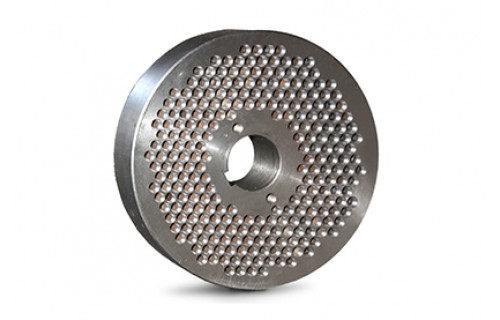
The pelletizing line of the company „TechnoMaszBud” was created taking into account that energy prices are rising year by year. We also tried to create a small plant that can be assembled independently. For example, different granulators with different performance indicators per 1 hour can be installed on the lines. You can also choose the speed of the belt conveyor, as well as order different dies so that pellets of different diameters can be produced.
You can also be guided by power indicators depending on what range of products needs to be produced during the month. In a word, we assemble our own pelletizing line adapted to the conditions of the enterprise. The example production volume ranges from 300 kg to 1000 kg.