Grain crusher – essential for feed production from grain

Probably no entrepreneur likes to waste raw materials or money. Fortunately, machines come to the rescue that can dramatically increase the efficiency of various production processes. In agriculture, and more precisely in the field of feeding livestock, such a device is, for example, a grain crusher – a simple device that significantly increases the efficiency of the produced feed. It is a good option for farmers who have decided to independently produce food for animals.
How does a grain crusher work?
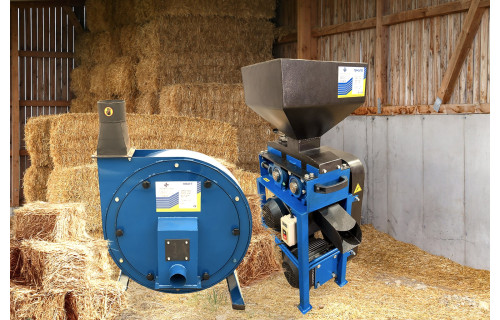
A grain crusher is a fairly simple, mobile and relatively small device. It consists of a hopper – dispenser, a crushing mechanism in the form of steel rollers with grooves, and an outlet. The entire structure stands on four adjustable legs. Some crushers are also equipped with a magnetic separator that captures unwanted metal particles that may have entered the grain.
The throughput of the crusher can be set using an adjustable working gap.
By using a screw conveyor, the grain crushing process can even be automated within a simple production line.
Once the crusher is configured, we can begin processing.
We pour feed grain into its hopper, which then goes between the crusher rollers. There the grain is subjected to crushing. Then, already in a modified form, the grains fall into a container under the device – this is the end of the process. This simple processing increases the digestibility of the grain by animal organisms by 20 percent compared to grain before crushing – this manifests itself in the form of greater weight gains in livestock.
Most crushers are intended for processing all types of cereals, as well as legumes. Crushed grain forms the basis for well-digestible and full-value feed for livestock – cattle, pigs, horses.
High processing temperatures can destroy the protein present in the grain – an important component of livestock diets. A good quality crusher operates at temperatures that do not threaten the nutritional value of the feed. The protein remains undamaged.
Own feed production – advantages
Producing feed for animals on your own is an attractive option primarily due to the possible reduction in animal feeding costs. Especially on farms that have their own grain, such a solution is economically profitable.
The purchase of machines such as a crusher or an feed extruder will over time prove to be more of an investment than an expense. It is estimated that with well-planned feed production for one’s own use, savings of 10–20 percent on animal feeding are possible.Own feed production and Polish law
It is worth remembering that, in accordance with Polish law, not everyone can freely conduct feed production on a farm. To do so legally, you must register with the District Veterinary Inspectorate as a feed producer. After registration, you will receive a dedicated veterinary number. For safety reasons, every person producing feed on their own must keep detailed documentation. The raw materials used in production must be properly described in terms of their origin. The finished feed should be stored in a properly labeled bag with an appropriate label. Its appearance and the information it contains are regulated by legal provisions. If we plan to sell our own feed production, the number of required certificates and documents additionally increases.
Therefore, before starting independent feed production, it is good to familiarize yourself with the legal aspects in order to avoid unpleasant surprises in the future.
06/11/2024 15:39:29
3036