First start-up of the granulator. Die break-in process
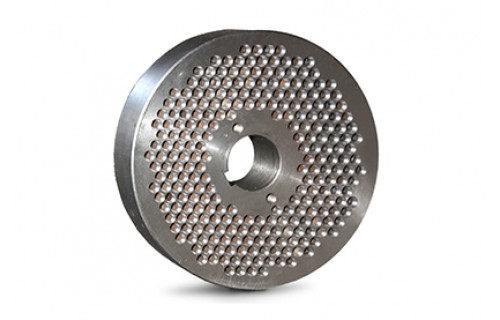
During the first start-up of the granulator, there is a high probability of obtaining low-quality pellets or a dry mixture. This may cause the die to become clogged with raw material, regardless of its type. The reason for this is the unpolished internal surface of the die holes.
Let us look at the causes of this phenomenon and the ways to solve them:
First: The granulator is new, and therefore the die in it is also new (unpolished), so it should be polished (polish the channels in the die) with a special mixture. The manufacturer does not carry out this procedure because after polishing the die would lose its appearance. However, if necessary, polishing of the die is possible during production, which is agreed upon and carried out additionally.
Granulator die polishing procedure:
1. 5 kg of fine wheat grits (sieved, without flour) or wheat seed (fraction not larger than 2 mm). Add oil (about 1.5 l). The mixture should be sticky and uniform. When squeezed in the hand, the oil slightly separates from the polishing mixture, but does not drip. For this, it is necessary to leave the mixture for about 20 minutes so that it absorbs the oil. On granulators with a die Ø over 150 mm, the volume of the mixture should be increased by half, maintaining the specified proportion.
2. This mixture should be pelleted cyclically in small portions, collecting it at the outlet and feeding it into the hopper, gradually adding construction sand to the mixture in the proportion of 1 kg per 5 kg of feed. For the first time, the mixture without sand should be passed through the granulator, then collect the obtained product, add 150 g of sand per each 5 kg, mix well and pour again in portions into the granulator hopper. Pelletize until all the sand has been added to the mixture and the pellets begin to pour out evenly (up to 2 hours of operation, depending on the die).
3. After 30 minutes of grinding, sprinkle the rollers with oil (about 10 g), after some time repeat. During the grinding process, an additional 150-200 g of oil should be used for lubricating the rollers.
4. After some time, when the polishing mixture turns into flour and begins to stick, add another 1 kg of grits or grain (so that the mixture becomes loose), leave for 30 minutes and continue grinding.
IMPORTANT – under no circumstances should water be added, otherwise the mixture will stick together and clog the die.
After polishing the die, it is possible to work with other feeds, sawdust and other raw materials.
Second: The raw materials should be evenly moistened by 15%. Without specialized equipment, this can be done as follows: spread on a surface that does not let water through and spray the feed with an ordinary sprayer. Leave for 30 minutes so that the feed mixture absorbs moisture. The pelleted feed will be moist. During operation, the die heats up to 80 degrees Celsius, thanks to which the feed in the granulator undergoes heat treatment and thus dries. If necessary, the pellets should be spread on a flat surface for natural drying. The fraction of the feed (raw materials) should be 1 mm smaller than the diameter of the die holes.
Third: the feed should be supplied evenly, about 100-400 g at a time, depending on the model (visually, the rollers should be immersed to 1/3 of their height in the raw materials).
Fourth: granulators with a die Ø 100 mm are not intended for the production of fuel pellets. Hay and chaff can be pelleted by mixing them with grain feed mixture (60% hay, 40% feed mixture).
IMPORTANT – a gap of 0.1-0.15 mm should be maintained between the die and the rollers. This will significantly increase the service life of the die and granulator components.
In generally available operating conditions of granulators, the gap is set to the thickness of 2 sheets of A4 paper with a density of 80 g/cm2. A necessary condition – the roller should touch the sheet with a tooth, not with a groove. This method is used on new rollers and die. On worn parts, the rollers should be set relative to the die until they begin to rotate, turning the die “by hand”.
Rules for working with the granulator
1. Set the gap between the die and the rollers;
2. Adjust the ejector according to the thickness and the die and the installed intermediate sleeve;
3. Fill in the feed mixture;
4. Turn on the electric motor of the press;
5. Set the cutting tool to the required pellet length;
6. Feed the raw materials evenly into the working zone in small portions so as not to overload the electric motor and not allow it to stop or the belts to slip;
7. Repeat this process until the die heats up and the load on the press motor stabilizes. Then gradually increase the product supply and bring the load on the press electric motor to the nominal product supply. Raw materials should be supplied taking into account the above recommendations (the layer of raw materials covers 1/3 of the height of the rollers, about 100-400 g at a time, depending on the die diameter);
8. Monitor the quality of the pellets. Fresh pellets can be easily distinguished from those that have been in the die holes for a long time, as they have changed shade to dark green or even black and have a characteristic gloss;
9. If the obtained pellets are relatively hard, but a large percentage of the raw materials remains unpelletized, the amount of supplied water should be increased (try to evenly moisten the feed by spraying). Supply water until the number of unpelletized raw materials is minimized and the surface of the pellets still has gloss.
10. Pellets with a glossy surface may come out soft and this is not a sign of low-quality products, because after cooling the pellets quickly harden. If after adding water the load on the electric motor decreases, the supply of raw materials can be increased;
11. If the amount of unpelletized raw materials is minimal, but the surface of the pellets is rough, this means that the product has been over-moistened. In this case, either reduce the amount of supplied water or gradually increase the supply of raw materials. The percentage of moisture and the proportion of raw material supply depend on the type of raw materials, the die and the product itself.