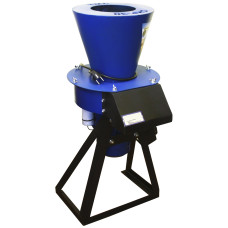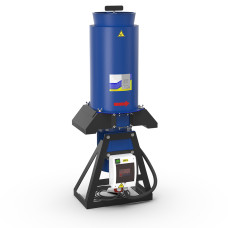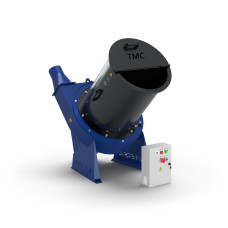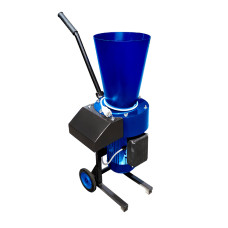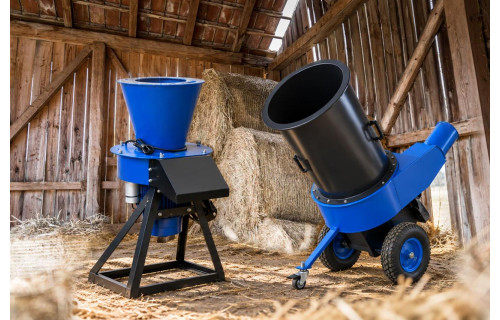
Are you planning to buy a straw and hay shredder? If you are reading this article, there is a good chance that you are. No wonder. Using shredders makes it possible to process straw, hay, grain, and other raw materials faster and more efficiently, reducing the time and labor required for their preparation. Thanks to this, you can make better use of the available biomass and produce feed, bedding, pellets, or briquettes. However, as is often the case nowadays, on the internet you will find plenty of conflicting opinions about the proper choice of this type of equipment.
As many self-proclaimed experts, so many opinions. It is not difficult to get confused.
What should you really pay attention to when buying a straw and hay shredder? Let us try to answer that today.
1. Determine what material you want to shred
The first step should be to determine the type of raw material that will be processed. This is quite obvious. Shredders can be used for cutting and shredding various types of material - straw, hay, grass, leaves, plant stems, or other materials of plant origin. Some models also allow grain milling.
It is therefore worth considering whether our machine will be used exclusively for straw and hay, or whether we need a more universal device. If you plan to process various raw materials, a good solution may be a model allowing the change of operating parameters and adjustment of the size of the obtained fraction. An example of such a multifunctional machine is the RD-250 - the scope of its “competences,” apart from hay and grasses, includes, among others, cardboard and grain.
2. Match the capacity to your needs
Another important parameter is, of course, the desired shredder capacity. A small farm, where the machine will be used occasionally, does not need equipment with the same capabilities as a large agricultural farm or a company engaged in professional biomass processing.
Before buying, it is worth estimating how much material you want to shred per hour. Too low a capacity can significantly extend the work, while an oversized machine may mean an unnecessarily higher purchase and operating cost. Check the specifications of specific models and do not overpay!
The devices available on our website are characterized by a capacity from 30 kg/h (RDS-30) to as much as 2 tons per hour (ALIGATOR - 18).
If you are not sure which model will best suit your needs, call us - we will be happy to help you choose the right equipment.
3. Check the possibility of adjusting the fraction size
This is important. We do not always need material shredded in the same way. Different requirements may occur when preparing bedding, different ones in feed production, and still others in further biomass processing.
Therefore, it is worth paying attention to the machine design and the possibility of adjusting the size of the obtained material. Interchangeable screens or meshes allow you to adapt the work result to a specific application. This is particularly important in the case of universal devices that can be used for various raw materials
4. Consider the power supply method and place of work
Before buying, you also need to check what power supply is available at the place where the machine will work. In the case of electric devices, important factors include, among others, the installation requirements and access to a three-phase power network.
The mobility of the device is also important. If the shredder will be used in different places around the farm, it is worth paying attention to its design and the possibility of easy movement.
If your electrical installation does not meet these requirements or you want a mobile petrol shredder that will be suitable for field work, no problem! We also offer models with a diesel engine.
5. Choose quality and a durable construction
Shredding straw, hay, and other raw materials is a demanding process. The construction and workmanship quality of the machine have a direct impact on its durability. When choosing, it is worth paying attention to the manufacture of the housing, rotor, knives, and other working elements.
Materials such as a solid steel construction, or wear-resistant alloy steel knives will allow you many years of trouble-free operation of your equipment. It is worth remembering that the durability of the device affects not only the service life of the chaff cutter, but also the safety and stability of work.
Check the possibility of expanding the workstation
Once again - you need to define your goals. If the shredder is to be part of a larger technological process, it is worth checking whether it can be connected with additional devices. The shredder can also be an element of a larger technological process in which the shredded material is then directed to subsequent devices, e.g. the KGM-100 pellet mill. Such solutions will improve your production and increase the efficiency of working with raw material.
So... which straw and hay shredder should you choose?
As is not difficult to guess, there is no single device that will be the best choice for every user. As we have shown above, when buying, you should primarily take into account the type of processed material, the expected capacity, the size of the obtained fraction, and the conditions in which the machine will work.
If you need a small device for occasional use, it is worth considering a compact electric chaff cutter. With a larger amount of material, a more efficient shredder adapted to intensive use may be a better solution. In turn, people looking for a more universal device may be interested in models allowing both the shredding of straw and hay and grain milling.
A good example of such a solution is the universal shredder and grain mill RD-150, which can be used for various types of raw materials. In the case of large quantities of material, it is worth paying attention to reliable and powerful machines for shredding bales and round bales, such as the RD 250 with PTO drive.
Need help choosing? We will be happy to help
If you still have doubts about which model will work in your case, contact us by phone,or send the contact form here. You can also test selected machines at our headquarters and check their capabilities in practice. We will help you choose a solution suited to the type of material and the scale of the planned work. Good luck in these difficult choices!