Pellet machines in every size – from small pellet mills to complex production lines

Biofuels have become an integral part of the energy landscape of our part of the world. Fuel produced from biomass attracts users with its low emissions, ease of use and, until recently, attractive price.
The undisputed leader among biomass fuels is definitely pellet.
Due to fluctuations in market prices, an increasing group of users of granulated fuel decide to produce it themselves.
The theory is very simple – to ensure energy independence we need biomass and a pellet production machine.
However, one more important factor must be included in this equation – scale.
It is not difficult to guess that the pellet production process will be different for a single-family house, different in the case of a medium-sized agritourism facility, and still different in a large, dynamically operating farm.
The pellet production machine market, similarly to the automotive industry, offers solutions in every segment tailored to diverse user expectations.
Before purchasing a pellet mill, it is worth estimating your demand so as not to buy a truck when only a small car was needed.
Let’s check how to choose the right equipment.
Pellet consumption
Before we start producing our own granulate, it is necessary to calculate our pellet demand. If you have previously used purchased pellet – you know your consumption. If not, you can easily calculate it.
This can be done based on heating bills (e.g. gas, electricity, coal) or by estimating annual demand.
Energy demand is given in kilowatt-hours per square meter, i.e. kWh/m². Depending on the insulation of the house, this number may vary, most often between 100 and 200 kWh/m²
High-quality pellet shows a calorific value of about 5 kWh/kg, in the case of homemade granulate with the addition of e.g. husks or hay, this value may be lower and fluctuate around 4 kWh/kg.
Let’s calculate it for a hypothetical house with the following parameters:
area: 120m²
energy demand: 120 kWh/m²
pellet calorific value: 5 kWh
For such a building, it would look as follows:
Energy demand:
120 kWh/m² x 120 m² = 14 400 kWh
Pellet consumption:
14 400 kWh ÷ 5,0 kWh/kg = 2880 kg of pellet per year, with reserve – 3 tons of pellet.
Types of pellet mills
Granulate production presses can be systematized based on production capacity expressed in kilograms of finished pellet per hour (kg/h).
Pellet mills are also divided into two main types.
Flat die presses are definitely the most popular type of pellet mill, which has dominated the small-scale granulate production market – all the models listed below belong to this group. Among flat die pellet mills, one can distinguish single-shaft models, available in versions with two, three or four rollers – i.e. rotating elements that press biomass through die holes. The more rollers, the higher the machine efficiency, because the raw material is processed faster and more effectively.
There are also ring die pellet mills, i.e. specialized machines intended mainly for industrial applications where high efficiency and continuous operation are required.
Another distinction may be the type of power supply. Most models available on the market assume operation in a place with constant access to electricity. An alternative to electric presses are gasoline pellet mills – more expensive to operate, but ensuring independence from the electrical installation.
For the purposes of our comparison, however, let us return to the criterion of pellet mill production capacity expressed in kg/h.
The comparison is as follows:
1. Devices for home use (up to 100 kg/h)
These are small presses intended for producing fuel for a single household.
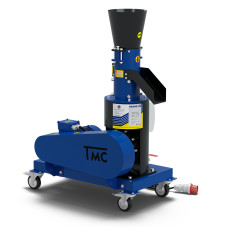
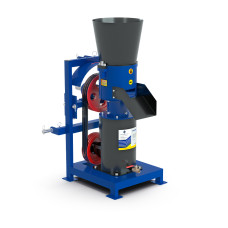
An example of such a device is PELLETNIK 150 (60kg/h).
Devices in this segment are characterized by simple construction. Small pellet mills are most often multifunctional presses that can also serve as feed granulators (after replacing the die with a thicker one).
These are easy-to-use devices, easy to transport, operating on electricity from a traditional “230V socket”.
2. Pellet mills for small farms and local producers (100–300 kg/h)
Devices in this class are slightly more efficient pellet mills, profitable for farms generating large amounts of biomass or for smaller wood processing plants.
Machines in this segment are also often available in multifunctional versions and, after replacing the die, can successfully be used in the production of granulated feed.
An example of such a press is PELLETNIk 260 (capacity: 250 kg/h for pellet and up to 500 kg/h for feed)
3. Industrial pellet mills (over 300 kg/h)
This is a pellet mill segment adapted for processing large amounts of biomass, as well as for continuous operation as part of a line, e.g. with a screw feeder. Most often they can also serve as granulators. Used in large farms, sawmills or carpentry plants.
Referring to the previously calculated hypothetical pellet consumption at the level of 3 tons per year – we can estimate that a pellet mill in such a configuration can, during one shift (8h), produce the equivalent of the annual pellet demand for a small insulated single-family house.
An example of such a device is PRIME-400 PRO.
4. Pellet production lines (from 150 to 700 kg/h)
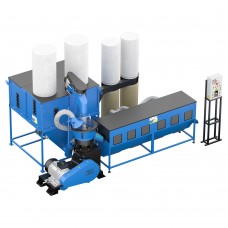
Pellet production lines are automated sets of devices that cover the entire pellet production process – from raw material preparation, through drying and granulation, to cooling and packaging. Unlike a single pellet mill, which is responsible only for forming granulate, production lines are intended for continuous work and on a larger scale. This does not mean, however, that a line must have higher efficiency than standalone granulators. The advantage of a line is uninterrupted operation and an automated process of delivering biomass into the device.
There are, of course, larger devices whose efficiency and size are limited only by the budget of investors and management boards ordering them for their plants. However, these are devices most often constructed to order for large companies engaged in large-scale granulate production. The largest factory pellet mills record efficiency at the level of even 10,000 kg/h.
In summary
Independent pellet production can take many forms – for some it will be a plot activity for their own use and a few neighbors, for others a profitable form of waste management that would otherwise have to be disposed of. Others treat the production and distribution of biomass fuels as an important source of income.
Regardless of which group you belong to – before purchasing a pellet press, familiarize yourself with the different types of devices and choose the one that best meets your expectations.